By Oke Peter
For a country struggling with persistent electricity shortages, inadequate transmission infrastructure and frequent power outages, the discovery that more than 300 containers of electricity equipment have been stranded at Nigerian ports for between 14 and 20 years is more than an administrative embarrassment. It is a damning reflection of how government bureaucracy, institutional inefficiency and poor project coordination can undermine national development.
The recent intervention by President Bola Tinubu, which has resulted in the release of 98 containers by the Nigeria Customs Service (NCS), deserves recognition. However, it also raises an uncomfortable question: why should equipment procured with public resources to improve electricity supply remain trapped at the nation's ports for decades while households, businesses and industries continue to struggle with unreliable power?

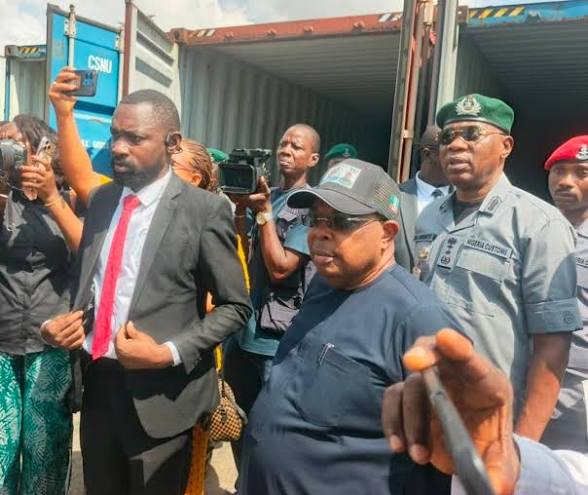
On Friday, November 6, 2026, Comptroller-General of Customs, Bashir Adewale Adeniyi, alongside the Minister of Power, Joseph Olasunkanmi Tegbe, flagged off the evacuation of the equipment at Apapa, Lagos.
According to the Customs chief, the first 44 containers were released from ENL Terminal, while another 54 containers from APM Terminals and Sun & Moon terminals were included in the exercise, bringing the announced total to 98 out of approximately 300 containers.
The consignments comprise high-capacity transformers, transmission cables, switchgear and other electrical equipment imported for the Federal Ministry of Power and agencies including the Transmission Company of Nigeria (TCN) and Niger Delta Power Holding Company (NDPHC).
Adeniyi disclosed that some of the equipment had remained uncleared for between 14 and 20 years. He attributed the breakthrough to President Tinubu's directive following a presentation by the Minister of Power at the Federal Executive Council, as well as the approval of waivers on accumulated charges by the Minister of Finance, Taiwo Oyedele.
The intervention is significant, but the history behind the development makes the situation even more troubling.
A history of abandoned national assets
The latest development is not Nigeria's first encounter with abandoned power equipment at its ports. On July 25, 2014, the then Minister of Power, Professor Chinedu Nebo, announced the release of 248 containers of electrical equipment imported by the defunct Power Holding Company of Nigeria (PHCN). Some of the consignments had arrived as far back as 2003, while others had remained at the ports for between seven and 11 years.
The abandoned equipment was reportedly required for electricity projects in more than 11 states, including transmission lines and substations in Kano, Nnewi, Epe, Ikorodu, Sagamu and other locations.
Nebo promised an investigation into the circumstances surrounding their abandonment, describing the development as a waste of national assets. The Jonathan administration also promised to ensure that the equipment was installed and put to productive use.
Two years later, another major recovery exercise emerged under the administration of President Muhammadu Buhari. In November 2016, the then Minister of Power, Works and Housing, Babatunde Fashola, announced the release of 330 containers of transmission equipment after negotiations with terminal operators. The exercise reportedly secured concessions worth approximately N2 billion on accumulated charges and penalties.

By January 2017, the government announced that more than 500 containers had been recovered, with equipment subsequently transported to TCN project sites.
Furthermore, TCN's February 2017 to October 2019 implementation report reportedly indicated that the company inherited approximately 800 stranded containers, cleared and delivered 775 to project sites, with most of the equipment installed. The recovered equipment was valued at approximately $83 million.
These historical figures are important because they demonstrate that successive administrations recognised the problem and undertook recovery exercises. Yet, years later, another 300-plus containers are being reported as stranded.
It is therefore necessary for the Federal Government to explain whether the latest 300 containers represent entirely different consignments, equipment overlooked during previous exercises or assets that became stranded again after earlier interventions. Publicly available records do not establish a definitive reconciliation.
What happened to the equipment?
According to Tegbe, the equipment was originally procured to expand the national transmission network, relieve pressure on overloaded substations and improve the country's capacity to deliver electricity.
Its absence has delayed infrastructure projects, restricted operational flexibility and left existing substations carrying loads that additional facilities were expected to share.
Sadly, electrical equipment exposed to prolonged storage, unsuitable environmental conditions and inadequate maintenance may require extensive testing, repairs or replacement before installation.
The government must therefore publish an inventory showing the equipment recovered, its original project destination, procurement value, present condition and installation status.
What is delaying the remaining 202 containers?
With 98 containers reportedly released, approximately 202 remain outstanding if the initial inventory of 300 is used as the baseline. Although Customs has introduced priority processing, dedicated examination officers and approved waivers, Nigerians deserve a clear explanation of the specific obstacles preventing the immediate evacuation of the remaining consignments.
Are there unresolved shipping charges, demurrage disputes, documentation problems, ownership questions, contractor-related issues or disagreements among government agencies?
The authorities must provide answers rather than allow another generation of equipment to become victims of administrative inertia.
Indeed, the Comptroller-General acknowledged that some contractors awarded government projects had imported equipment but abandoned the consignments without completing the projects. Such conduct deserves investigation, and contractors who collected public funds without delivering their contractual obligations should be held accountable.
Beyond releasing containers
The Tinubu administration must understand that releasing 98 containers is only the beginning, not the achievement Nigerians ultimately need. The remaining equipment must be evacuated within a clearly defined timeframe, technically assessed, matched to their original projects and installed wherever practicable. Obsolete or irreparably damaged materials should be properly accounted for, with responsibility established where negligence or misconduct is discovered.

The Ministry of Power, Customs, TCN, NDPHC and Nigerian Ports Authority must also establish a permanent coordination mechanism to prevent a recurrence. There should be no room for political differences, personal interests, bureaucratic rivalry or institutional buck-passing when national infrastructure and public welfare are involved.
Nigeria cannot continue spending billions of naira importing electricity equipment only to allow it to gather dust at its ports. Neither can a country seeking industrialisation afford to treat critical infrastructure materials as abandoned cargo.
The real measure of this intervention will not be the number of containers released at a flag-off ceremony. It will be how many transformers are installed, how many transmission projects are completed, how much additional capacity becomes available and, ultimately, how much improvement Nigerians experience in their electricity supply.
For a nation where millions spend heavily on generators and alternative energy, allowing electricity equipment to remain imprisoned at the ports for decades is an unacceptable price of governance failure.
Nigeria must stop celebrating the recovery of assets that should never have been abandoned in the first place.