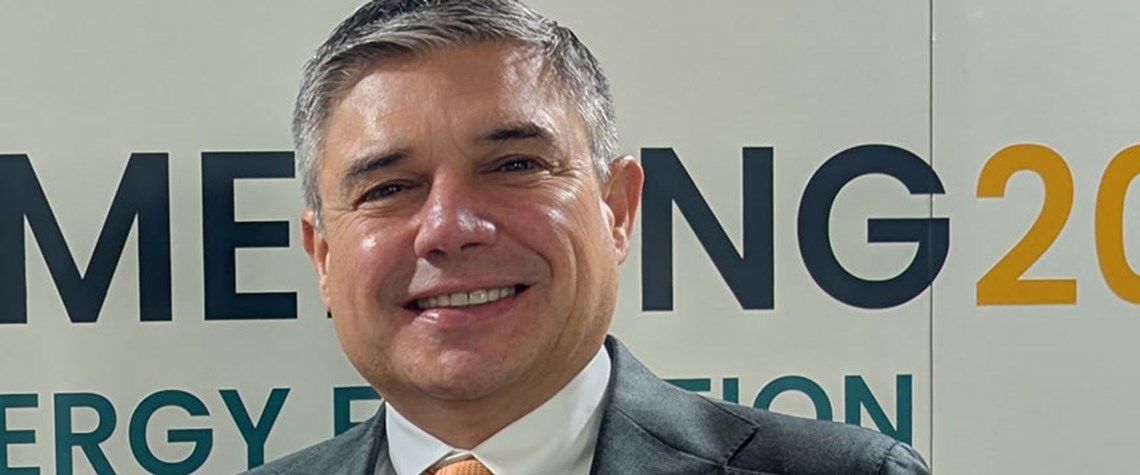
CEO Lorenzo Simonelli demands world must ‘rewrite the energy equation together’ amid relentless demand growth, the desire to improve affordability and accessibility, and to lower emissions without hurting supply
Energy technology bellwether Baker Hughes is in a unique position. It stands at the intersection of energy needs and technological transformation and, as a global leader, has its finger firmly on the pulse of where the industry is going. And in a period marked by surging energy demand, rapid technological disruption and geopolitical fragmentation, CEO Lorenzo Simonelli told Petroleum Economist in an exclusive interview that the global energy system is entering a fundamentally new phase.
“We are seeing demand remain very constructive,” Simonelli said. “If you look at the macro picture—population growth, rising consumption across three‑quarters of the world and the surge in electrification—the tailwinds are very positive” for consumption patterns.
From global population expansion to the rise of energy‑hungry datacentres, every major trend points towards a future of more energy consumption, not less. Simonelli noted that datacentre demand alone is expected to double by 2030, while overall electricity demand is set to soar beyond that.
“Natural gas is not a transition fuel. It is a destination fuel” Simonelli, Baker Hughes
Simonelli called for a fresh strategy: one that will require unprecedented collaboration, pragmatism and an “all of the above” approach when it comes to different energies and technologies.
Simonelli asked the question Baker Hughes looks well placed to solving and continues to address: how do we do more with less? Indeed, the argument is not substitution but efficiency and addition where the solution is electrification across the hydrocarbons chain and the complementing of oil and gas with clean solutions such as geothermal, nuclear, CCUS, wind, solar and more.
The energy tech leader is aware that the system is fragile and can be thrown out of balance. “We know that in the future, we need sustainable, affordable and secure energy,” he said. “We need to make sure it’s in balance—and that energy equation is consistently challenged.”
From an age of abundance to an age of constraint
Simonelli said the industry is entering a moment it has not confronted in decades: real constraints across infrastructure, generation, storage and supply chains. And new technologies—including generative AI—are accelerating demand faster than systems can adapt.
“What we had in the past is not going to be good enough for what is needed in the future,” he said. “Everything is arriving at the same time… population change, new technology, generative AI—and it brings us to this idea of rewriting the energy equation.
For Simonelli, rewriting that equation means tackling several pressures at once. This includes stretching existing infrastructure while deploying new capacity; improving recovery from mature assets; expanding energy storage options; commercial and regulatory innovation across government, NGOs and industry; and balancing decarbonisation with affordability and security.
He stressed that decarbonisation is essential—but must be achieved through pragmatism, not ideology.
“Natural gas is not a transition fuel. It is a destination fuel,” he said, highlighting its decades-long role in lowering carbon intensity. He sees parallel momentum in geothermal, hydrogen, wind, solar and nuclear. None will be sufficient alone.

CEO Lorenzo Simonelli at the Baker Hughes 2026 annual meeting
The investment squeeze
The sector’s long-running concern—underinvestment in hydrocarbons—is real. US shale is slowing after a decade of extraordinary productivity gains. Discoveries are fewer. And a wave of LNG projects arriving mid‑decade raises questions about what happens after the current buildout.
Simonelli acknowledged the uncertainty but remained upbeat about what technology can unlock.
“We are optimistic,” he said. “When we look at natural gas, LNG and what is possible with recovery from mature assets… through collaboration, partnerships and new models, we can have a positive outcome.”
But optimism requires policy alignment. Investment cannot occur without regulatory predictability.
“You need the regulatory framework. You need sponsorship at the state level [and], federal level, from NGOs and communities,” he said. “Without that, investment does not take place.”
A more complex, more volatile energy landscape
The CEO readily acknowledged the sector is navigating one of the most complex geopolitical and economic periods in decades.
“There is a better appreciation now for hydrocarbons and the role the energy sector plays,” Simonelli said. “People realise you cannot just flip a switch and move from one energy source to another.”
Yet even as attitudes shift, volatility persists. Deglobalisation and regionalisation are reshaping supply chains. Energy security has moved from a policy discussion to a national priority.
“Nobody wants to be dependent on one fuel,” he said. “Security, affordability and sustainability all have to be managed at the same time.”
“There is a better appreciation now for hydrocarbons and the role the energy sector plays… People realise you cannot just flip a switch and move from one energy source to another” Simonelli, Baker Hughes
Europe, he noted, illustrates the challenge. High energy prices have undermined industrial competitiveness, while the continent’s reliance on Russian gas exposed deep vulnerabilities.
“Every country is asking: how do I safeguard affordability, sustainability and security of supply?” he said. “That is the conundrum we need to solve in the energy equation.”
While crises undermine decarbonisation momentum—evident when Europe temporarily restarted coal plants—Simonelli remains pragmatic. “Companies are not moving away from lowering emissions. It makes financial sense.”
He stressed that technological upgrades—from valves to digital optimisation—can deliver simultaneous emissions reductions and production gains.
“If you just say everybody has to do something very costly, that is not the way to drive change,” he said.
For Simonelli, the path forward is grounded in innovation, pragmatism and the acceptance that no single energy source can solve the challenge.
The world must multiply energy options—not merely add them, appeared to be the underlying message from the CEO. He stressed the need to deliver radically better industrial outcomes by squeezing more from existing infrastructure, deploying new infrastructure faster and coupling technology innovation with commercial innovation.
Indeed, Baker Hughes’ pioneering accomplishments include advanced energy storage, namely via a partnership with Hydrostor. There is also gas resilience and storage with Dubai Petroleum to secure supply for industrial demand.
“Innovation, technology and collaboration—that is how we rewrite the energy equation,” Simonelli said. “It is how we scale large industrial solutions and expand energy sources at the same time.”
Source: Petroleum Economist