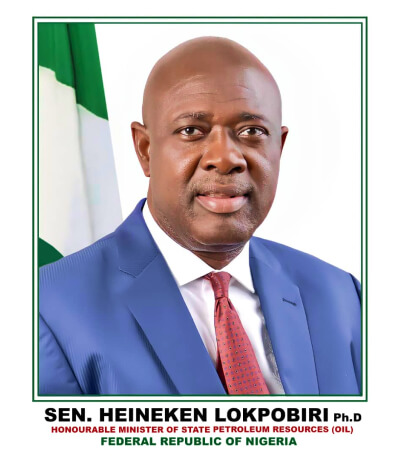
Hon. Senator Heineken Lokpobiri, Nigeria’s Minister of State for Petroleum Resources (Oil), has been confirmed as a featured speaker at African Energy Week (AEW) 2026, where he is expected to highlight Nigeria’s accelerating upstream transformation and growing status as one of Africa’s leading oil and gas investment destinations.
The announcement comes amid one of the strongest investment cycles in Nigeria’s energy sector in over a decade, driven by reforms introduced under the Petroleum Industry Act (PIA), improved fiscal incentives and renewed investor confidence from both international oil companies (IOCs) and indigenous operators.
In 2025 alone, Nigeria approved 28 new Field Development Plans valued at $18.2 billion, unlocking an estimated 1.4 billion barrels of crude oil reserves, according to government disclosures. Industry stakeholders say the approvals signal a decisive shift toward faster project execution and renewed momentum in upstream development after years of delays and stalled investments.
Lokpobiri has repeatedly attributed the renewed momentum to reforms under the PIA, streamlined licensing processes and investment-friendly fiscal adjustments. Speaking earlier this year in Abuja, the minister disclosed that Nigeria secured four of Africa’s seven major Final Investment Decisions (FIDs) between 2024 and 2025, reinforcing the country’s position as a leading upstream investment hub on the continent.

One of the flagship projects driving the resurgence is Shell’s Bonga deepwater expansion. The company recently took a $5 billion Final Investment Decision on the Bonga North project, a subsea tie-back expected to add more than 300 million barrels of recoverable resources while significantly boosting long-term output from the Bonga FPSO hub. Industry analysts view the project as a strong indicator of renewed confidence in Nigeria’s deepwater competitiveness.
ExxonMobil is also advancing plans to invest up to $1.5 billion in the Usan deepwater oil field between 2025 and 2027, targeting production revitalisation through new drilling campaigns and infrastructure upgrades.
Beyond the IOCs, indigenous producers are increasingly playing a strategic role in Nigeria’s near-term production growth. Heirs Energies is targeting output of up to 100,000 barrels per day through expanded development activities across its onshore Niger Delta assets, including OML 17.
Similarly, Seplat Energy continues to optimise its enlarged onshore portfolio following the acquisition of ExxonMobil assets, further strengthening the role of local operators in stabilising production and driving output growth.
At AEW 2026, Lokpobiri is also expected to outline Nigeria’s broader energy transition agenda, which aims to balance crude oil production growth with gas monetisation, domestic refining expansion and stronger local content participation. His policy direction has consistently emphasised creating a competitive environment capable of supporting both multinational investors and indigenous energy firms.
“Nigeria is once again proving what is possible when policy meets execution,” said NJ Ayuk, Executive Chairman of the African Energy Chamber. “Under leaders like Heineken Lokpobiri, we are seeing renewed seriousness about production, investment and getting projects across the line — from deepwater developments to indigenous-led growth. This is exactly the kind of momentum Africa needs: not promises, but barrels, projects and bankable deals.”
As African Energy Week 2026 prepares to convene policymakers, investors and industry leaders from across the continent and beyond, Lokpobiri’s address is expected to rank among the conference’s defining policy moments, placing Nigeria firmly at the centre of Africa’s evolving upstream growth story and its drive to convert fresh investment momentum into sustained production gains.