By Oke Peter
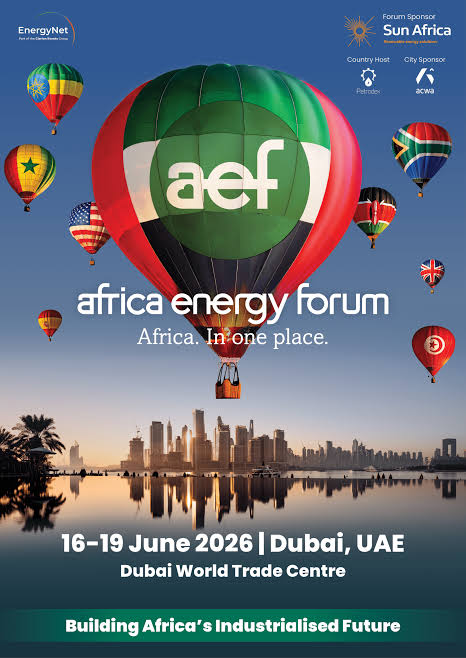
Registration is now live for the Africa Energy Forum (aef) 2026, taking place this June in Dubai — and this year marks a decisive shift in both narrative and ambition.
For decades, the development conversation focused on grid access, basic supply, and incremental progress. Today, that framework is no longer sufficient. As global demand for minerals, advanced manufacturing, and digital infrastructure accelerates, Africa’s energy agenda must evolve to match a far more ambitious industrial future.

Under the theme Building Africa’s Industrialised Future, AEF 2026 captures this pivotal moment. Industrialisation requires energy systems defined not merely by connections, but by megawatts delivered, transmission kilometres built, and baseload stability secured. It demands infrastructure capable of powering smelters, rail corridors, desalination plants, data centres, and rapidly expanding cities — all while safeguarding long-term development priorities.
Central to this discussion is the Just Energy Transition. Decarbonisation remains critical, but for Africa, “just” must also mean pragmatic and inclusive. It must protect jobs, strengthen water and food security, and support diversified energy strategies — including gas, renewables, and storage — aligned with national industrial goals.
Hosting AEF 2026 in Dubai adds further strategic relevance. The UAE’s evolution from a resource exporter to a diversified industrial and financial hub demonstrates what sustained vision, infrastructure investment, and sovereign capital can achieve. With Middle Eastern investors now among the leading financiers of African energy and infrastructure projects, the Africa–Middle East partnership is increasingly central to the continent’s next growth chapter.
The 2026 agenda reflects this shift, introducing closed-door leadership dialogues, an expanded focus on transmission and baseload capacity, critical minerals and pit-to-port corridors, regional fireside sessions, and a dedicated Africa–Middle East investment stream.
The message is clear: Africa’s energy conversation is moving from policy to projects — from basic access to industrial-grade reliability, resilience, and scale.