By Oke Peter
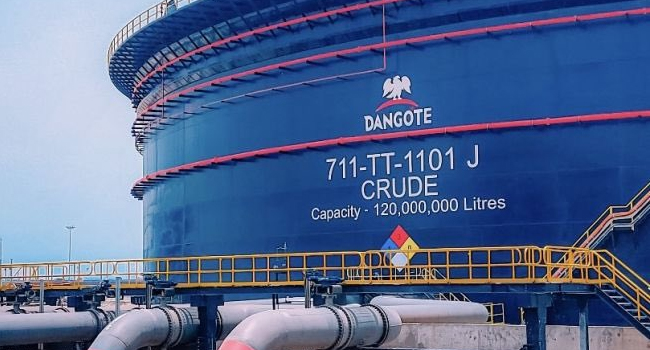
The Africa Finance Corporation (AFC) has revealed that the continent will require at least two additional refineries on the scale of the Dangote Refinery to meet its growing fuel demand, noting that about 70 percent of refined petroleum products consumed in Africa are currently imported.
This was disclosed in the AFC’s State of Africa’s Infrastructure Report (SAIR) 2026, unveiled on Thursday in Nairobi, Kenya, during the Africa We Build Summit.
Presenting the report, AFC’s Chief Economist and Director of Research and Strategy, Rita Babihuga-Nsanze, highlighted Africa’s continued vulnerability due to its dependence on exporting raw materials while importing refined products.
According to her, “Around 70 percent of Africa’s refined fuel consumption is imported, exposing the continent to global supply shocks and supply chain disruptions. Demand is expected to grow by 56 percent by 2040, creating an import gap of 86 million tonnes — equivalent to at least two Dangote-sized refineries.”

She added that East Africa presents a particularly strong opportunity for refining expansion due to limited infrastructure in the region.
The report, titled “The Africa We Build: From Capital to Systems,” shifts focus from resource scarcity to system inefficiencies. It argues that Africa’s primary challenge is no longer a lack of capital or infrastructure, but the absence of integrated systems needed to convert these resources into scalable industrial output.
Babihuga-Nsanze noted that while Africa possesses abundant capital, energy, transport networks, and industrial inputs, these remain poorly connected, limiting productivity and investment opportunities.
The report estimates that the continent holds over $4 trillion in domestic capital across banking, pensions, insurance, sovereign funds, and development finance institutions. However, much of this capital remains underutilised due to weak mechanisms for channeling funds into long-term infrastructure and industrial projects.
In addition, the report introduces a new mapping framework linking transport systems with mineral resources, arguing that industrialisation depends on aligning these elements, which have historically been developed separately.
On financing, AFC reported a sharp decline in external funding, with official development assistance to Africa dropping by 23 percent in 2025 — the largest annual decline on record. It, however, noted that effective mobilisation of domestic capital could offset this shortfall.
The report also criticises Africa’s traditional “pit-to-port” transport model focused on exporting raw commodities, calling instead for integrated systems that support domestic trade and industrialisation.
In the aviation sector, it highlighted the role of air transport in advancing trade under the African Continental Free Trade Area (AfCFTA), citing countries such as Kenya, Rwanda, and Ethiopia as examples of growth driven by liberalisation, infrastructure investment, and strong national carriers.
On energy, AFC stressed the need to move beyond household electrification toward powering industries. It noted that Africa currently adds between 6.5 and 8 gigawatts of power annually — far below the estimated 20 gigawatts required to meet development goals.
The report identified key challenges, including transmission bottlenecks, climate vulnerabilities, and fragmented power grids, calling for a comprehensive overhaul of energy systems through regional integration and increased private sector participation.
It also pointed to significant opportunities in fertiliser production. Despite holding about 80 percent of global phosphate reserves, Africa produces only around 20 percent of phosphate-based fertilisers. The report highlighted strong potential for expansion, particularly in East Africa.
In digital infrastructure, AFC noted that while mobile connectivity reaches approximately 85 percent of the population, a wide usage gap persists, limiting economic impact. It called for investment in the “missing middle” of digital ecosystems to drive productivity and growth.

Overall, the report concludes that Africa’s central challenge lies not in resource availability but in the lack of integrated systems to unlock value at scale.
Responding to the findings, Lerato Mataboge, Commissioner for Infrastructure and Energy at the African Union Commission, said they align with ongoing continental initiatives such as the Single African Air Transport Market and the Single Electricity Market Programme. However, she noted that progress remains slow due to weak cross-border coordination and nationally focused planning.
She called for mandatory regional infrastructure planning, stronger alignment with intra-African trade goals, and improved joint resource mobilisation.
Energy economist and Chief Economic Strategist at the ECOWAS Commission, Professor Ken Ife, also emphasised the need for increased investment in refining and value chain development within the oil and gas sector.
He stated that boosting domestic refining capacity is crucial for Africa to reduce dependence on external partners and strengthen energy security.
Professor Ife further urged regulatory bodies, including the Nigerian National Petroleum Company Limited (NNPCL), to create a more enabling environment for local investors to thrive.