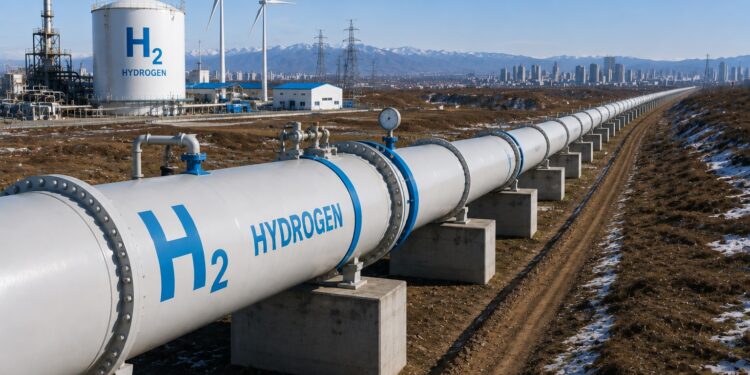
By the year 2060, China will need approximately 59,000 km of specialized hydrogen pipelines with a total cost of almost $55 billion. The need for construction at this scale is explained by the fact that storage and transportation are already making up 20% to 50% of the final cost of hydrogen today. Such was the conclusion reached by scientists from Shandong University.
Today, most studies estimate the cost of hydrogen production and transportation separately, although it is the combination of these factors that determines the profitability of the fuel for the end consumer. The authors of the new study have for the first time decided to consider the entire supply chain, from the production site to the industrial consumer. To that end, they collected data from all of China’s provinces and calculated the production costs of grey hydrogen (which is derived from coal and natural gas), blue hydrogen (produced via carbon dioxide capture) and green hydrogen (produced using wind and solar).

These data were then integrated into a transportation model that took into account three delivery methods: by tanker trucks in gaseous or liquid form and by specialized pipelines. The latter option is the most complex from a technical standpoint.
While several hydrogen pipelines of this kind already exist in China, these are merely short industrial pipelines with a length of 25–42 km connecting refineries and chemical plants within industrial clusters. The first such pipeline was built in Nanjing by Sinopec back in 2008 to connect a Jinling Petrochemical refinery to a Yangzi Petrochemical complex.
This time, the scientists simulated a single trunkline network that can connect different regions of China. They only considered a pipeline economically feasible if two conditions were met: the distance between regions had to be sufficiently large and the annual transportation volume had to exceed a certain threshold. Road transportation would be cheaper otherwise.
Analysis showed that coal-based hydrogen production remains the cheapest method, costing some $2–2.8 per kg, while hydrogen produced through solar electrolysis can cost up to $12 per kg. However, the picture changes when transportation costs are taken into account. The advantage of low production costs in China’s inland regions is partially canceled out by shipping costs, as the major consumers are concentrated in industrialized coastal provinces.
As a result, for 22 of the 23 importing regions, imported hydrogen turns out to be more expensive than locally-produced hydrogen, with the difference exceeding $3.5 per kg in the largest industrial provinces (Guangdong and Jiangsu). The only exception is Tibet, where it is more cost-effective to import hydrogen than to produce it domestically.
According to the researchers’ calculations, currently only a few major interprovincial pipelines that connect the resource-rich northwestern regions of China with Beijing, Shanghai, Guangdong and other industrial centers on the east coast are economically feasible.
Their length totals about 39,400 km. During their simulation of the industry’s development to 2060, the scientists considered three demand scenarios ranging from 55 million tons of hydrogen per year to 187 million tons per year. A network of 25 interprovincial trunklines proved to be the most efficient in every scenario. As demand grows, the necessity will arise to increase the capacity of the existing pipelines instead of building new routes.
The length of the pipeline grid will total about 59,000 km as a result, with the average hydrogen transportation distance reaching 2,522 km. The researchers emphasize that specialized hydrogen pipelines must be used instead of conventional gas pipelines, since hydrogen can cause embrittlement of steel.
Source: Global Energy Association