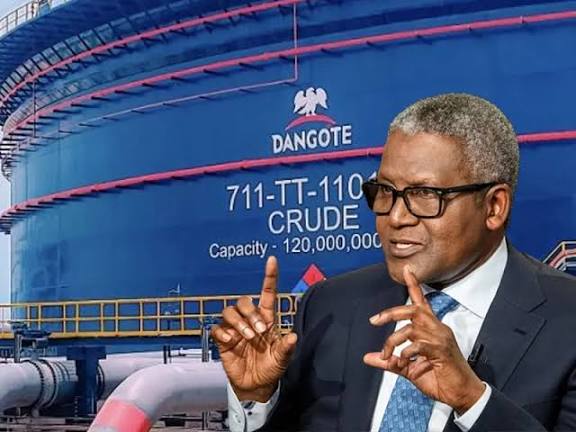
President of the Dangote Group, Aliko Dangote, has revealed plans to broaden the company’s footprint into steel manufacturing, electricity generation, and port infrastructure as part of a wider strategy to fast-track industrial development across Africa.
In a statement issued on Monday, Dangote said his long-term objective is to strengthen the continent’s manufacturing capacity beyond oil refining and establish Africa as a competitive industrial powerhouse on the global stage.
His most recent major venture, the Dangote Petroleum Refinery & Petrochemicals, is currently operational, producing roughly 650,000 barrels of refined products per day. He noted that output is projected to double within three years as expansion plans advance.

Speaking in a recent interview with The New York Times, Dangote explained that refining represents just one stage of a broader industrial vision. He emphasised that the next areas of focus will include steel production, improved electricity supply, and the construction of additional ports to support large-scale manufacturing and trade.
Market analysts believe that entering the steel industry would position the group in a sector vital to infrastructure development, housing, and heavy industry. Meanwhile, investments in power generation and port facilities could help tackle longstanding barriers to Nigeria’s economic growth.
Dangote cited Tata Group of India as an example of successful diversified industrial expansion, highlighting how its presence across multiple sectors has contributed to economic transformation.
He also stressed that job creation remains central to the group’s strategy. With Nigeria expected to need between 40 and 50 million new jobs by 2030, Dangote argued that large-scale industrial projects are crucial to absorbing the country’s expanding youth population.
Currently, the refinery employs around 30,000 workers, about 80 per cent of whom are Nigerians. Expansion into new sectors is projected to increase total employment across the group to approximately 65,000.
Dangote further disclosed plans to list shares of the refinery on Nigeria’s stock exchange, a move aimed at expanding local ownership.
Despite notable progress, he acknowledged ongoing challenges, including infrastructure deficits and crude supply constraints. He has previously pointed to logistical bottlenecks and inefficiencies in the oil value chain that complicate feedstock supply to the refinery.
Nevertheless, Dangote reaffirmed the group’s commitment to investing heavily in industries that reduce reliance on imports and retain greater economic value within Africa.
With cement plants operating in several African countries and a refinery that has reshaped Nigeria’s downstream energy landscape, the planned expansion into steel, power, and port infrastructure marks a new phase in Dangote’s broader ambition to industrialise the continent.