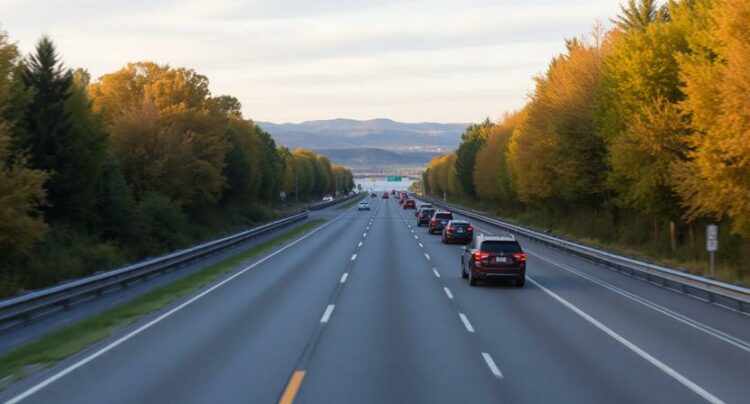
In the United States, compliance with speed limits would save on a daily basis more than 23 million liters of fuel, about $18 million, and prevent nearly 50,000 tons of CO₂ emissions. At the same time, average travel time would increase by only 54 seconds per day. This is the conclusion reached by researchers from the University of Minnesota, who analyzed more than 120 million real-world vehicle trips.
The scientists used traffic data from different seasons of 2021. For every vehicle, the speed at any instant, the kind of road, the prevailing speed limit along the route, and even the elevation change along the itinerary were recognized. Using a physical vehicle motion model accounting for air resistance, rolling resistance, and other parameters, the researchers calculated fuel and electricity consumption under different driving regimes. They then modeled two scenarios: in the first, drivers simply stopped speeding on highways and major roads; in the second, they additionally reduced speed in advance to avoid hard braking. The study covered internal combustion engine vehicles across virtually the entire United States, as well as electric vehicles in California, where their share was large enough for statistical analysis.

It turned out that 43% of all trips contain at least one speeding episode. On average, speeders drive about 18 km/h above the speed limit and spend about 12% of their trip time in this mode. However, the time gain is practically negligible: if all drivers were to keep within the limits, average trip duration would increase by less than one minute per day.
At the same time, the energy and environmental benefits of speed limit compliance would be far more significant. According to the researchers’ calculations, daily savings would amount to more than 23 million liters of fuel, about $18 million, and the prevention of roughly 50,000 tons of CO₂ emissions. On an annual basis, speed compliance would save about 2.4 billion gallons of gasoline (approximately 9 billion liters), comparable to the annual fuel consumption of about 5.5 million passenger cars.
For internal combustion engine vehicles, fuel consumption would decrease by 2.4 – 3%. For electric vehicles, the effect is even more pronounced: speed limit compliance would reduce electricity consumption by more than 9%. The researchers explain this by the fact that electric motors maintain high efficiency across a wide speed range, whereas internal combustion engines operate less efficiently at reduced loads. In addition, about 20 million tons of CO₂ emissions could be prevented annually.
The American scientists note that these estimates are conservative, as the analysis covered only roads with speed limits of 45 mph (about 72 km/h) and above. If slower urban streets were also considered, the potential fuel savings and emission reductions could be even higher. In any case, the study clearly demonstrates that driver compliance with speed limits simultaneously reduces fuel consumption and costs while cutting environmental impact with virtually no time penalty.
Source: Global Energy