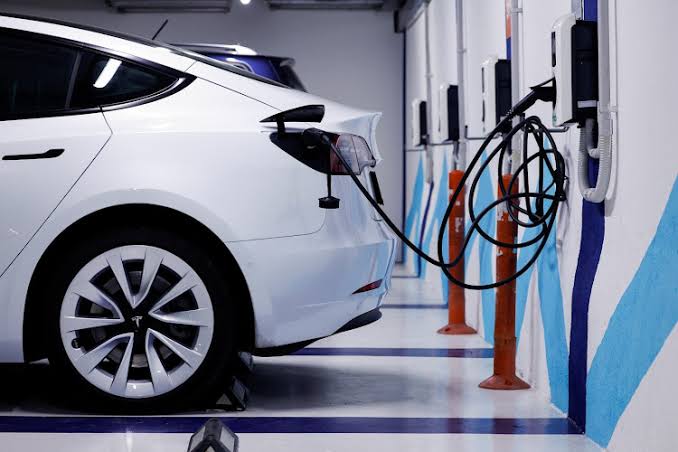
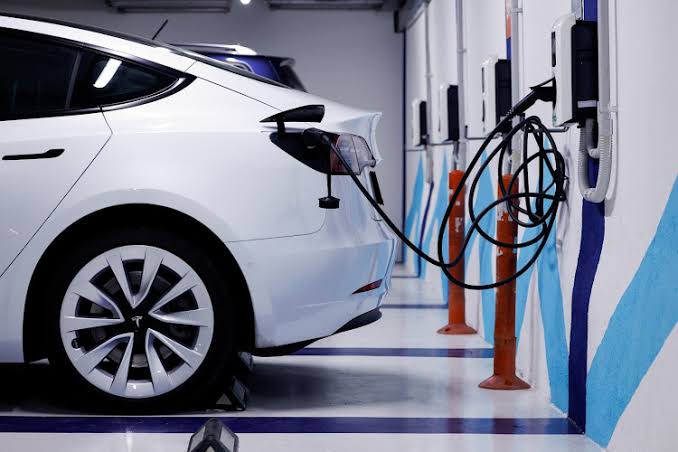
 An electric vehicle
The growth will be less noticeable in the US: given the current policy, the share of e-vehicles sales will reach 11%. The uncertainty in the sphere of future tax concessions affects the dynamics, however, the existing support measures continue to incentivize the consumers’ demand. In the emerging economies, especially in South-East Asia and Latin America, 50% growth is expected – up to 1 mln vehicles. This became possible thanks to the inflow of relatively cheap Chinese models and local support measures including tax and customs loosening.
The situation with prices remains very diverse from region to region. In China in 2024, two thirds of sold e-vehicles turned out to be cheaper than their analogues with internal combustion engines – even without accounting for subsidies. In Europe, on the contrary, the average price of an e-vehicle remains 20–50% higher than the prices of gasoline-fueled cars. Similar situation is observed in the US: the average price of e-vehicles is 30% higher than the prices of cars with internal combustion engines, and the number of available e-vehicles remains limited. In some emerging economies, such as Brazil, Indonesia, Mexico and Thailand, supplies from China helped to reduce the price gap dramatically, and in some segments it practically disappeared. At the same time, steady reduction of the batteries’ costs is observed: in 2024, the average global prices of battery units decreased by more than 25% as a result of cheaper feedstock, growing competition and production scale-up. In China the price reduction was 30%, in Europe and the USA – between 10 and 15%.Against the background of the overall market growth the relative role of direct government support is reduced. In 2024, subsidies made less than 7% of the cumulative costs of purchasing e-vehicles, while as in 2017 their share exceeded 20%.
Electrification of transport will allow for reducing the global oil consumption by over 5 mln bpd by 2030, and 50% of this effect will be achieved on account of China.
Source: Global Energy Association