Nigeria’s efforts to restore stability to its troubled electricity sector have suffered a major setback following the Federal Government’s cancellation of $717.7 million in undisbursed funding under the World Bank-backed Power Sector Recovery Performance-Based Operation (PSRO).
According to a World Bank restructuring paper obtained by Nairametrics on Tuesday, the cancellation followed a formal request by the Federal Government on March 26, 2026, as both parties agreed to discontinue financing under the programme and redirect support towards alternative interventions.
The restructuring document revealed that the entire undisbursed balance of $717.7 million would be cancelled, while the programme’s closing date was brought forward from June 30, 2027, to May 31, 2026.

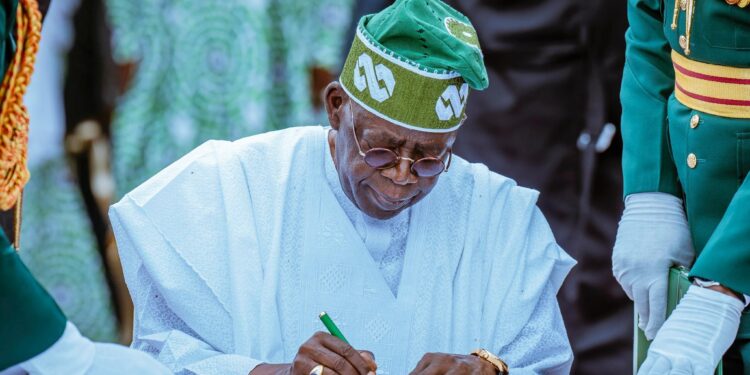
•President Bola Ahmed Tinubu
“The restructuring will result in the cancellation of the entire undisbursed balance in the amount of $717.7 million equivalent, and no further disbursements will be made under the programme following approval of this restructuring,” the document stated.
It added that the revised closing date was intended to facilitate the completion of all disbursement activities and pave the way for the programme’s formal closure in line with World Bank procedures.
The development comes amid worsening financial and operational challenges in Nigeria’s electricity sector, including mounting tariff shortfalls, weak revenue collection, foreign exchange pressures, and persistent infrastructure deficiencies across the power value chain.
The World Bank attributed the collapse of the programme largely to the sharp deterioration in the sector’s financial position following the liberalisation of the foreign exchange market and the inability of electricity tariffs to keep pace with rising generation costs.
According to the report, the June 2023 foreign exchange reforms significantly increased the cost of natural gas used for electricity generation, with gas pricing denominated in US dollars. Since more than 70 per cent of electricity supplied to the national grid is gas-fired, operating costs surged sharply.
Despite the rising costs, electricity tariffs remained largely frozen for most consumers, except Band A customers whose tariffs were adjusted to cost-reflective levels in April 2024. This widened the gap between sector revenues and operational costs, resulting in a steep rise in tariff deficits.
The World Bank disclosed that annual tariff shortfalls rose dramatically from N140 billion in 2022 to N1.9 trillion in both 2024 and 2025, placing significant pressure on government finances and undermining key reform targets tied to the programme.
The lender further noted that the absence of a credible financing framework to address the growing deficits prevented Nigeria from meeting several critical performance indicators between 2023 and 2025.

Beyond tariff-related concerns, the report highlighted longstanding structural weaknesses within the sector, including poor distribution performance, transmission bottlenecks, underutilised generation capacity, high technical and commercial losses, and weak cost recovery mechanisms.
The PSRO was initially approved in June 2020 to support Nigeria’s broader Power Sector Recovery Programme aimed at improving electricity supply, restoring financial sustainability, and strengthening accountability within the industry.
The World Bank acknowledged that the original phase of the operation recorded measurable gains between 2019 and 2022, with tariff shortfalls declining by 71 per cent from N581 billion to N166 billion, while regulatory cost recovery improved from 56 per cent to 94 per cent. Electricity supplied to distribution companies also increased by 13 per cent between 2018 and 2021.
Encouraged by those improvements, the bank approved an additional financing package of $750 million in June 2023 to deepen reforms and tackle lingering structural challenges. The facility became effective in June 2024 and extended the programme until 2027.
However, implementation later stalled.
The World Bank disclosed that none of the programme’s global performance indicators was achieved under the additional financing arrangement due to delays in establishing a fiscally sustainable financing plan, slow implementation of institutional performance improvement measures, and challenges in meeting verification requirements linked to disbursement conditions.
As a result, only about nine per cent of the additional financing package was disbursed before the programme was halted.

The lender subsequently downgraded implementation progress from “satisfactory” to “moderately unsatisfactory” as reform timelines slipped and disbursement targets remained unmet.
Data contained in the restructuring document showed that the operation had total commitments of about $1.51 billion from the International Bank for Reconstruction and Development (IBRD) and the International Development Association (IDA). Of that amount, roughly $796 million had been disbursed before the cancellation, leaving $717.7 million undrawn.
The development comes months after the Accountant-General of the Federation, Dr. Shamseldeen Babatunde Ogunjimi, warned that Nigeria could reconsider participation in World Bank loan arrangements if approval and disbursement processes continued to suffer prolonged delays.
Ogunjimi stressed that the funds sought from the World Bank were loans rather than grants and argued that Nigeria, as a responsible borrower, deserved timely consideration and release of approved project funds to support its development priorities.