By Oke Peter
Lagos - As Nigerian businesses invest heavily in alternative power, the protection, distribution and control systems inside their facilities will determine how effectively that investment supports productivity.
Across Nigeria, reliable power has become an operational responsibility as much as a utility service. Manufacturers and commercial facilities increasingly combine grid electricity with generators, gas-powered systems and solar installations to maintain continuity. Yet generating additional power addresses only one part of the challenge.
The way electricity is distributed, switched, protected and controlled inside a facility ultimately determines how effectively that investment supports productivity.
Nigerian manufacturers spent ₦1.34 trillion on alternative power in 2025, up from ₦1.11 trillion a year earlier, according to the Manufacturers Association of Nigeria. In October 2025, the national grid wheeled 5,506 MW from an installed capacity of 13,625 MW, according to the Nigerian Electricity Regulatory Commission (NERC). Against this backdrop, factories, offices and commercial buildings increasingly operate with a mix of grid electricity, diesel, gas and solar power.

•Koon San Ang, Vice President, Himel International.
Investment in generation helps secure access to electricity. Protecting the value of that investment depends on what happens after power reaches the facility: how it is distributed, switched and protected as a site moves between different sources. This is an area Himel has supported in Nigeria for more than eight years through its local partner, Bolamark.
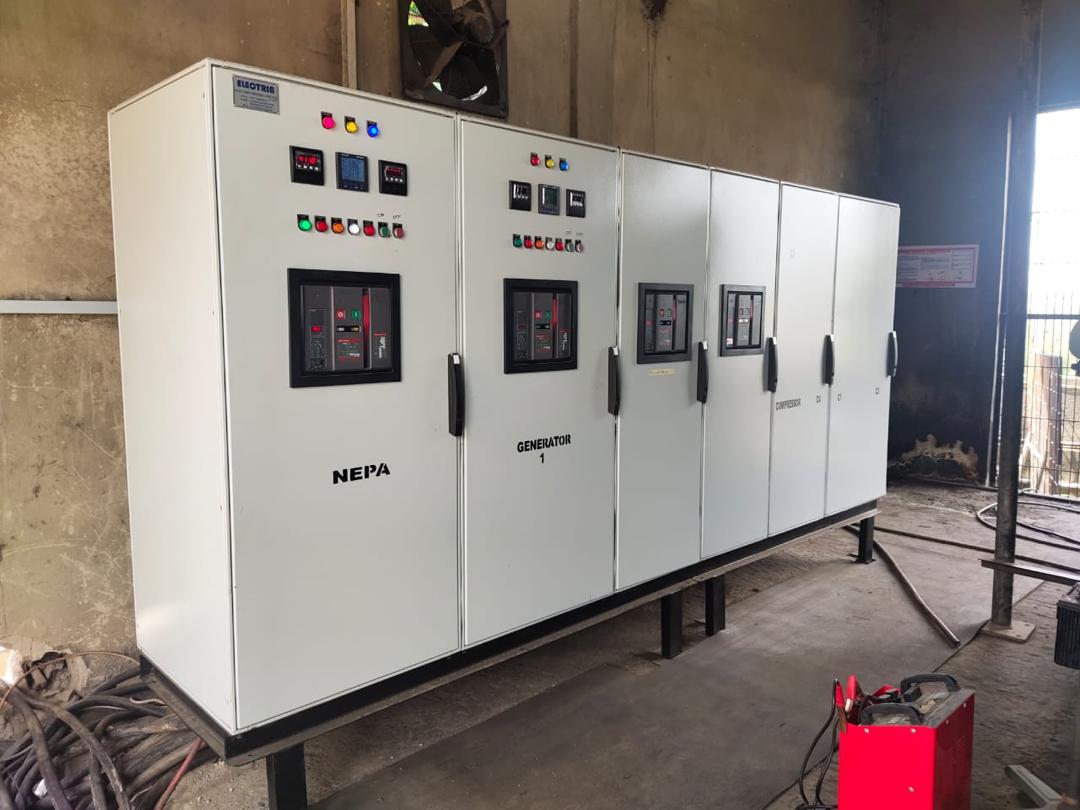
These applications are already visible across Nigeria’s industrial and built environment. In manufacturing, FMCG and beverage facilities, air circuit breakers and moulded case circuit breakers support the distribution of higher electrical loads and help isolate faults before they affect wider production systems. Automatic voltage regulators help maintain more stable voltage conditions for machinery and connected equipment where fluctuations can affect performance, reliability or equipment life.
In residential developments, distribution boards and miniature circuit breakers organize and protect individual circuits serving homes and shared facilities. In commercial and government buildings, ACBs and MCCBs support reliable power distribution and fault isolation across offices, services and common areas. Although the scale and operating demands vary by sector, the objective remains consistent: prevent a localized electrical problem from becoming a wider operational disruption.
“Nigerian businesses have already made significant investments to keep their operations running. The next priority is ensuring that the electrical system inside each facility protects that investment and helps prevent an isolated fault from causing a wider operational disruption,” said Koon San Ang, Vice President, Himel International.
Protection helps secure an electrical system, but efficiency determines how much value a business obtains from every unit of electricity it generates or purchases. Motors, pumps, HVAC systems and lighting do not always need to operate at full output.
Contactors, variable speed drives, smart relays, controllers, and energy and building management solutions can align their operation more closely with actual demand. For a facility relying partly on self-generated electricity, reducing unnecessary consumption can translate directly into lower fuel use and operating costs.
This is the principle behind Himel’s global I Love Control campaign, part of its Powering Infinity vision: making practical control and automation technologies more accessible to businesses of different sizes. For Nigerian manufacturers and building operators, the opportunity is not only to secure additional power, but also to use that power more intelligently across plants and facilities.
Himel’s electrical protection, distribution and control solutions are available in Nigeria through its long-standing local partner, Bolamark. The partnership, established more than eight years ago, supports local product availability for industrial, commercial and residential applications.
Nigeria’s businesses have already demonstrated their willingness to invest in continuity. The next stage is to ensure that the power they generate or purchase is distributed safely, protected effectively and used efficiently. For manufacturers, commercial operators and developers, electrical resilience is no longer defined only by access to another source of power. It is also defined by what happens inside the facility after that power arrives.