By Oke Peter
Lagos State is taking a clear lead in Nigeria’s electricity reform journey, positioning itself as the country’s most practical example of how states can drive power development outside the limitations of the national grid.
Nigeria’s electricity supply has remained unstable for decades, with the national grid frequently collapsing and power generation often falling short of demand. Although Nigeria’s installed generation capacity is estimated at over 13,000MW, actual available supply is typically between 3,000MW and 5,000MW due to gas constraints, transmission limitations, and poor infrastructure performance. This gap has continued to hurt households, industries, and small businesses nationwide.

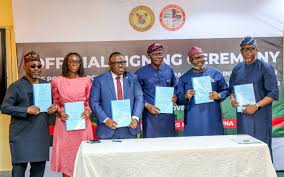
•Governor Babajide Sanwo-Olu (middle) and members of the managements of Mainland Power Limited and Fenchurch Power Limited, during the signing of the power purchase agreement in Lagos, on Monday.
Against this backdrop, Lagos is pursuing a different approach, building an independent, state-managed electricity market backed by private sector investment and enforceable power purchase agreements.
The state’s move gained stronger momentum following the Electricity Act 2023, which empowered states to establish their own electricity markets. Lagos subsequently enacted the Lagos State Electricity Law in 2024, laying the legal foundation for full regulatory control of electricity generation, distribution and supply within the state.
By June 2025, Lagos officially assumed regulatory authority over intrastate electricity matters, becoming one of the first states to operationalise full control of its local electricity market, previously under the Nigerian Electricity Regulatory Commission (NERC).
The most recent major step came on April 27, 2026, when the Lagos State Government signed power purchase agreements with three independent power firms—Mainland Power Limited, Fenchurch Power Limited (in partnership with Aggregate Utilities), and Viathan Engineering Limited. The agreements are aimed at improving electricity supply to critical infrastructure and expanding Lagos’ energy availability through embedded generation.
The firms currently deliver about 60MW combined, supplying electricity to essential facilities such as public hospitals, waterworks, and government institutions. Under the new agreements, Lagos expects supply capacity to scale up significantly, with projections indicating that the partnerships could raise output to between 200MW and 400MW within the next two to three years through rehabilitation of existing plants and new investments.

One key plant expected to benefit from the expansion is the Akute Independent Power Plant, which is strategically positioned to support Lagos’ water supply system and other public utilities.
Unlike older electricity contracts that often forced governments to pay for power whether delivered or not, Lagos’ model is structured around a “pay-as-delivered” system. This means the state will only pay for electricity actually supplied and metered, a shift designed to improve transparency, reduce waste, and encourage serious investment from power developers.
Governor Babajide Sanwo-Olu described the initiative as part of Lagos’ strategy to reduce dependence on the national grid and deliver reliable electricity to homes, businesses, and public institutions.
Energy analysts say Lagos’ approach is gaining attention because it aligns regulation, demand and commercial viability in a way Nigeria’s broader power market has struggled to achieve. With clear demand concentration and a large economic base, Lagos offers investors a more bankable environment than the national grid system, which is often affected by liquidity challenges and weak revenue collection.
The development is also influencing other states, as reports indicate that more than 20 states are exploring pathways to establish independent electricity markets, encouraged by the decentralisation framework created by the Electricity Act 2023.
However, Lagos’ progress does not eliminate existing sector challenges because gas supply remains a major risk, as most thermal plants depend on steady gas availability. Foreign exchange volatility, high equipment costs, and weak national transmission infrastructure could also affect long-term stability, especially where power supply still requires interconnection with the wider grid.
Despite these hurdles, Lagos is steadily building a template for how sub-national governments can take charge of power delivery. Its strategy is not built on policy declarations alone but on signed agreements, measurable megawatt targets, and commercial structures that reduce inefficiencies.
If the state succeeds in expanding supply toward its 400MW projection and delivering stable electricity to key public and industrial areas, Lagos may well become Nigeria’s strongest case study of how electricity reform can move from promises to performance.