By Oke Peter
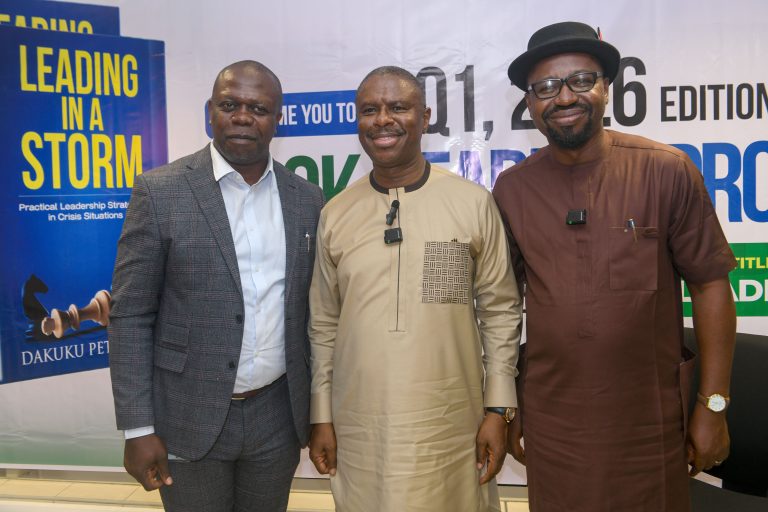
The Nigerian Content Development and Monitoring Board (NCDMB) on Wednesday at its Conference Centre (Rose 1101) hosted the first quarter 2026 edition of its Book Reading Series, with a one-time Director-General of the Nigerian Maritime and Safety Administration (NIMASA), Dr. Dakuku Peterside, as Guest Author.
The event, which focused on the 2025, 204-page publication of the author, Leading in a Storm: Practical Leadership Strategies in Crisis Situations, had a capacity audience drawn from higher institutions, the mass media, Association of Nigerian Authors (ANA), and Nigerian Institute of Public Relations (NIPR), with several others participating virtually.
In a welcome address, the Executive Secretary of the NCDMB, Engr. Felix Omatsola Ogbe, represented by the General Manager, Corporate Communications Division (CCD), Dr. Obinna Ezeobi, said the book reading programme, which he described as “a signature event” of the Board, speaks to creativity, which is one of the core values of the Board.
He explained that the event is part of the Board’s strategy in fostering intellectual activity and sophistication among stakeholders as well as building the abilities of Nigerians to operate productively in the oil and gas industry and linkage sectors, which is one of its core mandates.
The Executive Secretary enumerated several initiatives of the Board geared towards advancement of research and technology, notably, six Centres of Excellence in the nation’s six geopolitical zones, each of which has a unique theme. These are Niger Delta University, Amassoma, with Marine and Petrochemical Technologies as theme; Federal University of Technology, Minna (Engineering Design), and Federal University of Technology, Owerri (Local Raw Materials Substitution).

Others are Modibbo Adama University of Technology (MAUTECH), Yola (Safety and Environment Studies); Usman Dan Fodio University (UDUS), Sokoto (Renewable Energy), and Federal University of Technology, Akure (Geology and Geophysical Studies). Additional research centres established by the Board include Geosciences Research Centre at the University of Lagos and Marine and Offshore Training Centre at Rivers State University, Port Harcourt. The latest is the Centre of Excellence in Gas Development at Delta State University, Abraka, being developed in partnership with Seplat Energy Plc.
According to Engr. Ogbe, the NCDMB is collaborating with Renaissance Africa Energy Company Limited (RAEC), First Exploration and Petroleum Development Company Limited, and the Nigerian Society of Engineers (NSE), to organise the first Nigerian Engineering Olympiad (NEO), which was launched on November 20, 2025 in Abuja. The Olympiad, slated to end in April, 2026, is to encourage final-year and postgraduate students to be innovative in applying engineering principles to real-world operational challenges in and out of oil and gas industry.
In the book conversation segment, moderated by Mr. Victor Binawari, Dr. Peterside explained the inspiration behind Leading in a Storm…, copies of which had been distributed gratis to attendees. “My own lived experience,” he declared, informed the contents and thrusts of the work. He pointed out that “Every single day, Nigerians face one crisis or another,” and that the experiences posit weakness of leadership.
He recalled his time at the National Assembly, when he served as Chairman of the House of Representatives Committee on the Downstream Petroleum sector, with the unremitting crises in fuel supply. As NIMASA Director General he had to contend with recurring incidences of piracy within Nigeria’s territorial waters. Then the COVID-19 pandemic, which saw many world leaders fumbling, unable to determine how best to safeguard the health of citizens. Yet another inspiration was from an uncomplimentary remark by a professor at America’s Kellog School of Management, to the effect that “Africa is in a near-permanent state of crises.”
“I began to investigate how leaders can perform better in crisis situations,” he explained, adding that calmness, clarity, adaptability, and resilience, are critically important. What kind of choices leaders make when faced with crises would reveal the stuff they are made of.
He outlined eight competencies of crisis leadership, namely, Contextual intelligence (“the ability to read situations accurately and understand the deeper forces at play”); Calm Confidence (which provides emotional stability); Sense-making (which enables a leader to find patterns in chaos and make meaning from confusion); Strategic Decision-making; Clear Communication; Strategic Flexibility; Coordinating Teamwork, and Facilitating Learning. Every great leader should rank high enough in these.
On his style, which relies heavily on storytelling, he stated that stories are relatable, memorable and engaging, and that “stories teach you principles which you can apply.”
In closing remarks, Mr. Teleola Oyeleke, Supervisor, CCD of NCDMB, thanked Dr. Peterside for readily accepting the invitation and for the wealth experience he shared at the event. He also thanked all participants, while advising them to read and digest the contents of the book. He also echoed the Guest Author in challenging attendees to have personal development programmes.