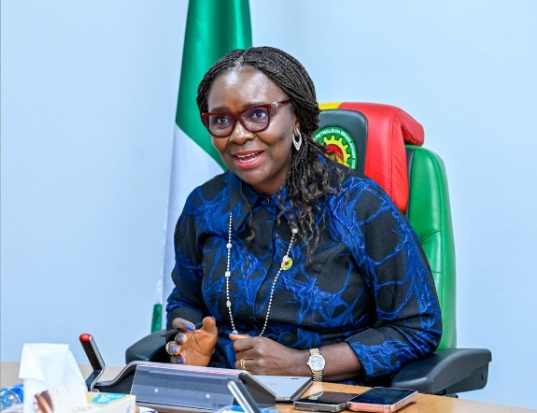
Nigeria has introduced a long-term energy development plan aimed at accelerating economic growth, expanding energy access, and addressing climate change concerns, the Nigerian Upstream Petroleum Regulatory Commission (NUPRC) has said.
The Commission Chief Executive, Engr. Oritsemeyiwa Eyesan, disclosed this on Monday at the Offshore Technology Conference (OTC) 2026 in Houston, Texas, where she presented Nigeria’s new roadmap titled “Energy Evolution.”
According to Eyesan, the framework outlines a transition strategy spanning 2030 to 2060, designed to balance Nigeria’s fossil fuel advantages with long-term sustainability objectives. She explained that the plan seeks to scale up renewable energy development while positioning natural gas as the country’s key transition fuel for households, industries, and emerging technologies.

“The future we envision is integrated and inclusive,” Eyesan said, noting that Nigeria would expand cleaner energy sources while maintaining gas as a stabilising resource for growth and energy security.
She stated that the roadmap prioritises tackling energy poverty, particularly in rural communities where dependence on biomass for cooking remains widespread, posing significant health and environmental risks.
Eyesan called for stronger international collaboration and urged global investors to commit capital to Nigeria’s upstream oil and gas sector, as well as offshore innovation and decentralised power solutions.
“We invite investors to work with us in shaping the future of offshore energy and in decarbonising existing assets,” she said.
Reaffirming the relevance of Nigeria’s oil and gas sector, Eyesan said upstream petroleum resources would remain central to the country’s energy future despite global momentum toward cleaner alternatives. She stressed that sustained public and private sector investment would be critical to achieving Nigeria’s transition objectives.
She highlighted Nigeria’s resource strength, noting that the country’s gas reserves are projected to last 85 years, while oil reserves could last about 59 years, positioning Nigeria as a potential regional energy hub and dependable global supplier.
Eyesan also referenced shifting global energy patterns, pointing out that oil’s share of global energy consumption has dropped from 38 per cent in 1990 to 30 per cent in 2026. Similarly, Nigeria’s biomass use has declined from 74 per cent to 49 per cent within the same period.
However, she stressed that Nigeria’s core challenge remains energy access, rather than decarbonisation alone.
“Energy transition in Nigeria is fundamentally about replacing biomass and ensuring reliable energy for millions,” she said.
Eyesan explained that the roadmap builds on Nigeria’s energy history—from coal mining in Enugu to the discovery of crude oil in Oloibiri in 1956—and reflects the country’s gradual evolution into a more diversified energy economy.
She added that the Federal Government’s “Gas-First” policy continues to drive Nigeria’s industrial development and power generation plans, supported by major infrastructure projects including Nigeria LNG Train 8 and the Ajaokuta–Kaduna–Kano (AKK) and OB3 gas pipelines.
According to her, these projects are expected to unlock up to two billion cubic feet of gas per day for industries, power generation and fertiliser production.
Eyesan said Nigeria is also strengthening efforts to end gas flaring and expand cleaner domestic energy consumption in line with the Nigeria Energy Transition Plan (NETP), which targets net-zero emissions by 2060.
She noted that investments in renewable energy, offshore wind, ocean-based technologies, and carbon capture, utilisation and storage (CCUS) would help reduce emissions without undermining oil and gas production.
Eyesan concluded that Nigeria’s long-term energy ambitions can only be realised through sustained partnership among government institutions, investors and industry stakeholders.
“Upstream remains the bedrock of our energy future, but innovation, inclusion and collaboration will determine how far and how fast we go,” she said.