By Oke Peter
The Commission Chief Executive of the Nigerian Upstream Petroleum Regulatory Commission (NUPRC), Mrs. Oritsemeyewa Eyesan, has reaffirmed the Commission’s commitment to creating a business-friendly regulatory environment and supporting the Federal Government’s gas expansion agenda.
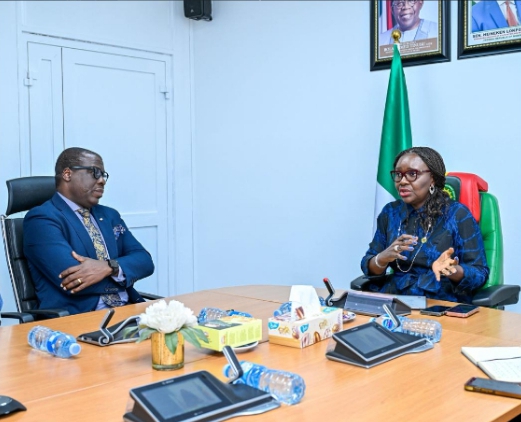
Eyesan restated the position during a courtesy visit by the Managing Director of Nigeria LNG Limited (NLNG), Mr. Adeleye Falade, who led a delegation to the Commission.
Receiving the team, Eyesan described the visit as timely, noting that since December, the Commission has intensified reforms aimed at aligning regulatory processes with the Petroleum Industry Act (PIA).

•Managing Director of Nigeria LNG Limited (NLNG), Mr. Adeleye Falade and the Chief Executive of the Nigerian Upstream Petroleum Regulatory Commission (NUPRC), Mrs. Oritsemeyewa Eyesan, during the visit.
“We are deliberately repositioning the Commission as a business enabler,” she said. “Through our monthly stakeholder engagements, we X-ray industry performance and resolve issues proactively to ensure they do not escalate.”
The NUPRC chief further linked the government’s responsiveness to improved investor confidence and a rise in final investment decisions across the oil and gas industry.
She emphasised that the Federal Government’s Decade of Gas initiative is designed to deliver tangible outcomes, not just policy ambitions.
“The Decade of Gas is not aspirational; it is a practical framework for expanding domestic utilisation while strengthening export capacity,” Eyesan said.
Calling for greater industry alignment, she urged operators to match government reforms with stronger performance and compliance.
“As government continues to be responsive, operators must demonstrate reciprocity through performance, compliance, and investment discipline,” she added.
In his remarks, Falade stressed the importance of upstream collaboration in sustaining gas supply and ensuring long-term growth of the LNG value chain.

He highlighted NLNG’s domestic liquefied petroleum gas (LPG) strategy as a deliberate intervention to deepen the local market and increase access.
“Today, 100 percent of our LPG production is dedicated to the domestic market—not due to reduced output, but because demand has expanded significantly,” Falade said.
He also expressed optimism about NLNG’s expansion programme, noting that Train 7 is expected to come on stream next year and boost production capacity.
“Train 7, expected to come on stream next year, will increase our production capacity by about 35 percent, positioning us to scale both domestic supply and export volumes,” he said.