Pensana has signed a US$160 million equity investment agreement to support the development of its Longonjo rare earth project in Angola, marking a significant step forward for the company’s upstream mining plans and downstream ambitions in the United States. Once approved, the financing is expected to act as a catalyst for project construction and integration into global magnet-metal supply chains.
The agreement brings together key strategic partners, including Angola’s sovereign wealth fund FSDEA and support from the U.S. Government, alongside advisory roles from ABG Sundal Collier. Pensana said the investment underlines growing international backing for diversified, secure rare earth supply, particularly as demand rises for materials critical to clean energy technologies and advanced manufacturing.
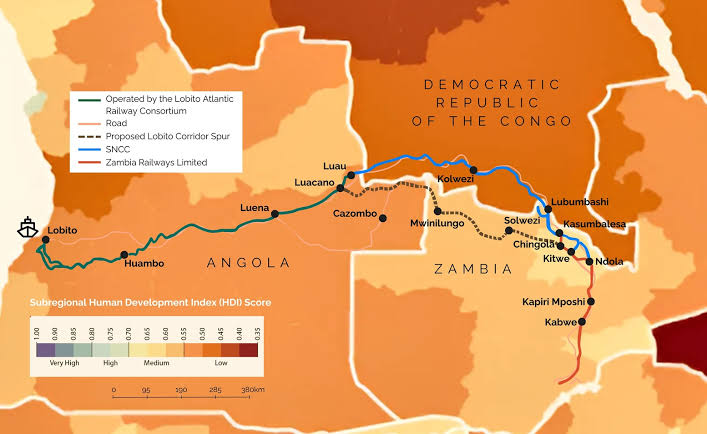
The Longonjo mine’s location near the Lobito Corridor rail network also strengthens its strategic importance, providing a direct logistics link to the Atlantic coast and reinforcing the corridor’s role in enabling export routes for critical minerals.
The Lobito Corridor emerged as one of the defining themes of this year’s Investing in African Mining Indaba in Cape Town, reflecting its growing status as a globally watched infrastructure programme. Discussions emphasised that the Corridor should not be understood simply as a railway project, but rather as a portfolio of interconnected investments designed to reshape regional trade flows. By linking mining regions to export routes while integrating logistics, energy, and industrial development, the initiative signals a shift beyond traditional “pit-to-port” thinking toward a broader economic corridor model.

On a panel organised by the Africa Finance Corporation (AFC), speakers framed the Lobito Corridor as a strategic artery for multiple sectors. While critical minerals remain central — particularly copper and cobalt from the Central African Copperbelt — the route is also intended to support agricultural exports and the movement of refined petroleum products. The focus on the Zambia-Lobito Railway (ZLR), an 830-kilometre greenfield line connecting Chingola to Luacano, highlighted how new infrastructure could provide a lower-cost and lower-carbon transport option for mineral exports. This framing positions the Corridor not only as a logistics upgrade, but as a lever for improving supply chain resilience and sustainability at a time when global demand for energy-transition minerals is intensifying.
Importantly, the AFC session underscored that the Corridor’s credibility rests on strong institutional backing. The presence of major development finance partners — including the African Development Bank (AfDB), the Development Bank of Southern Africa (DBSA), and the U.S. International Development Finance Corporation (DFC) — reinforced the perception of the project as financially and politically anchored. Their involvement suggests the Corridor is being treated as a long-term regional transformation platform rather than a standalone transport investment.
A separate Indaba panel brought operational perspectives to the fore, featuring Nicolas Gregoir, the COO of Lobito Atlantic Railway (LAR) alongside industry stakeholders. Here, discussion moved from strategy to implementation, with emphasis on how infrastructure connectivity can unlock downstream value chains. Beyond mining, the Corridor was presented as a potential catalyst for agricultural transformation by reducing transport bottlenecks, opening export channels, and improving regional integration. Taken together, the panels suggested that the Lobito Corridor is evolving into a test case for whether large-scale infrastructure in Africa can successfully combine resource logistics, industrial policy, and broader economic development into a single coordinated vision.
The Lobito Corridor: Between ambition and traction
The Lobito Corridor is now the centrepiece of Western-backed infrastructure policy in Central Africa. More than $10 billion in combined commitments from public and private actors, led by the Lobito Atlantic Railway consortium, make it one of the largest connectivity projects on the continent.
But in Zambia, the corridor remains a plan. The key Jimbe–Chingola section has yet to start construction. Financing discussions are still ongoing, and the earliest realistic start date for works is in 2026. Without that link, the corridor is not operational for Zambian exports. For most operators in the Copperbelt, established routes toward Durban, Beira, and Walvis Bay remain the only viable options.
For now, only small pilot shipments of copper cathodes are being discussed. None of the major mines — Kansanshi, Sentinel, Lumwana, Mopani, Lubambe — have announced export strategies involving Lobito. The corridor exists on paper, not in the daily operations of the industry.
Across the border, the Democratic Republic of Congo shows what the corridor could become. Kamoa-Kakula has already sent trial shipments to Lobito, cutting transport time from nearly a month to just over a week. The model works where infrastructure exists. Zambia’s side is the missing link.
The corridor’s potential advantage lies in efficiency and predictability. If the rail connection to Chingola materializes, it could open new export routes and reduce reliance on southern ports. But the gap between projection and execution is still wide.
Source: Lobito Corridor