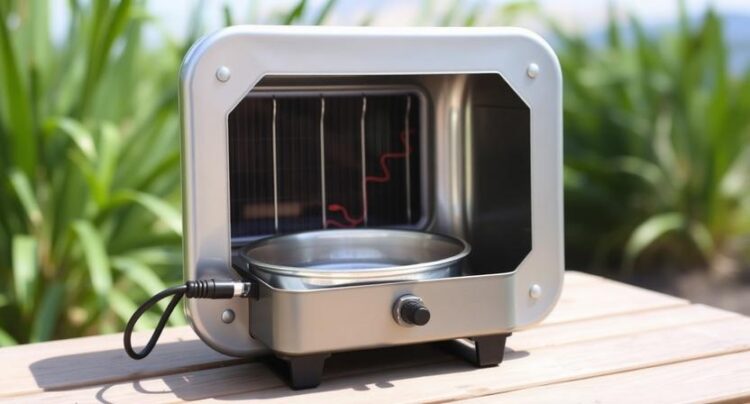
The researchers at King Mongkut’s Institute of Technology Ladkrabang have developed a portable solar cookstove equipped with a thermal storage system based on a erythritol-glycerin mixture. The system not only allows users to harness solar energy while cooking but also to partially store for later use.
Solar cookers are recognized as an exceptionally affordable cooking device in the areas without access to electricity or traditional fuel. However, their widespread use is limited by one drawback: cooking requires only intense sunlight. Any cloud cover or decrease in solar activity leads to a rapid drop in temperature and the increase in cooking time. However, Thai scientists have significantly extended the operating time of stoves by using a heat-storing material accumulating solar energy during the day and releasing it while cooking.
They chose erythritol, a food-grade sugar substitute melting at 118°C and distinguished by a very high latent heat of fusion – 336 J/g. This means it can absorb a large amount of energy when transitioning from a solid to a liquid state, and then release it back as it solidifies.

However, practical tests showed that under normal Thai sunlight, the erythritol, in a solar collector, heated up to only 83°C did not fully melt, which means its inability to accumulate enough heat for cooking rice (the region’s staple food). Then, the researchers mixed erythritol with glycerin in a ratio of 75% to 25% by weight. The mixture’s melting point dropped to 107°C, which made it much easier for the material to transition to a liquid state under solar heating, although the latent heat of fusion decreased to 302 J/g.
To test the effectiveness of the new technology, the researchers created a computer model of heat transfer and verified it through laboratory experiments. The calculated and the actual temperatures at the center of the pot differed by less than 4°C, confirming the model’s reliability.
Based on these calculations, a prototype solar rice cooker was developed. It consists of a solar collector and a double-walled pot with some space between the walls and beneath the bottom filled with a heat-storing mixture. This allowed heat to reach the food from virtually all sides.
Testing under three conditions was made in Bangkok in March.
First, rice was cooked using only sunlight, without heat-storing material. This took about 240 minutes.
Then the researchers tried to cook using only the stored heat, heating an erythritol-glycerin mixture in the sun. However, this approach did not work as the material melted only partially, and the stored energy was insufficient for cooking the food.
A combined method showed the best results. First, the researchers heated the heat accumulator in the sun, and then continued to use solar energy in the cooking process. In this case, the rice was fully cooked in two and a half hours, and the temperature inside the pot reached the 70–75°C required for cooking. Compared to a conventional solar cooker, the cooking time reduced by nearly half.
The main design limitation is still an incomplete melting of the heat-storage mixture under the influence of sunlight. Therefore, in the future, the researchers plan to either select new compositions with a lower melting point or to improve the solar collector and reflector system to increase the concentration of solar radiation.
Source: Global Energy Association