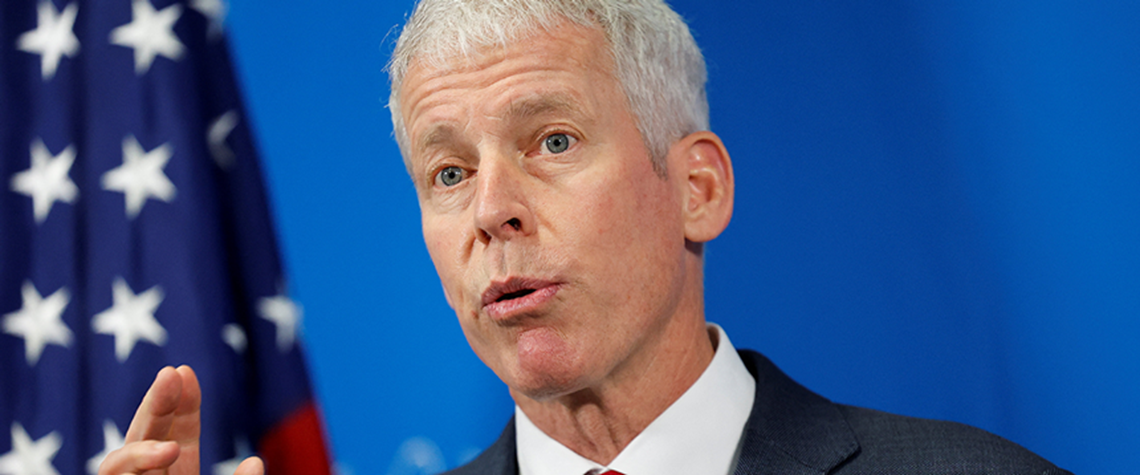
“We achieve prosperity at home and with our allies through energy abundance—affordable, reliable, low-cost energy drives economies, drives productivity [and] drives innovation,” Burgum said in a keynote address. “Peace is achieved around the world by selling energy to our friends and allies, so that they do not have to buy from our adversaries.”
“Peace is achieved around the world by selling energy to our friends and allies, so that they do not have to buy from our adversaries” Burgum, Interior Secretary
By adversaries, he was chiefly referring to Russia, which he described at one point as China’s “little discount gas station”, a reference to Beijing’s continued import of large quantities of Russian oil and gas.
Russian pipeline gas and oil flows to the EU are already at an all-time low. TurkStream, the only pipeline still delivering Russian gas to the bloc, pumped only 47mcm/d of gas in the first eight months of this year, according to data from the European Network of Transmission System Operators for Gas, or 17.2bcm/y on an annualised basis—down from a pre-war level of over 150bcm/yr.
Hungary and Slovakia are now the only EU member states still receiving Russian pipeline gas, and they are also the only remaining buyers of Russian crude oil, having received an exemption from the bloc’s embargo that came into force in 2023. Whether the two countries can be coerced into giving up Russian energy is another matter. They remain strongly opposed to doing so and could potentially find ways to bypass any restrictions imposed either by the EU or the US.
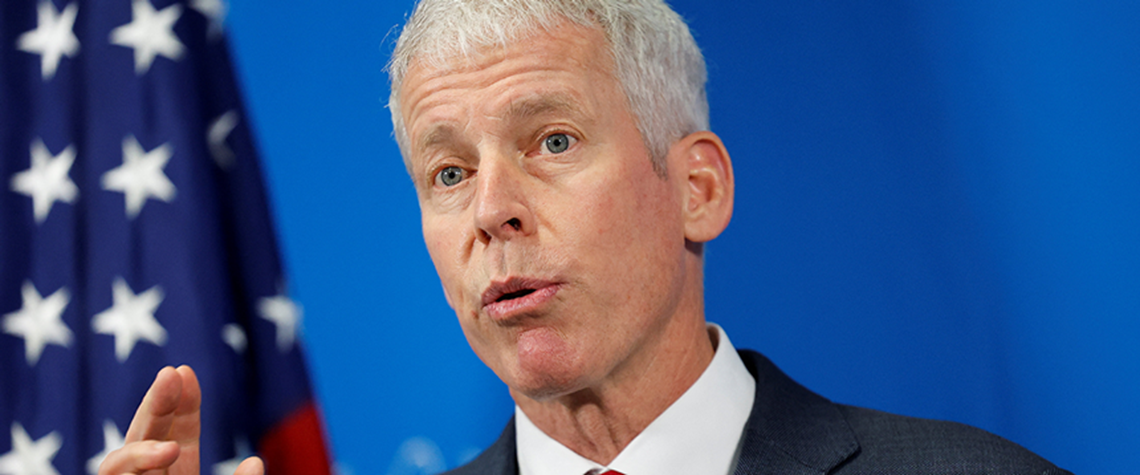 US Energy Secretary Chris Wright
Notably, the EU still imports significant quantities of Russian LNG, with supplies surging to a record 17.4mt in 2024.
Wright spoke plainly about the US aim to supplant Russian energy in Europe entirely. “We want to fill that hole as Europe closes it off for Russian energy—we want to fill that with American energy,” he said.
Europe is effectively “funding both sides of the war”, he said, by supplying Ukraine with arms and financial aid on the one hand and continuing to provide Russia with oil and gas revenues on the other.
The quest for energy dominance also extends to Asia-Pacific. Burgum talked up the prospects for Alaska LNG, a project first proposed a decade ago that has gained a new lease of life under the Trump administration. The 20mt/yr terminal’s lead developer, Glenfarne, has recently signed preliminary offtake deals with Japan’s JERA, South Korea’s POSCO, Taiwan’s CPC and Thailand’s PTT.
The tariff threat Beyond the “peace and prosperity” rhetoric, commercial and economic interests also guide this US pursuit. Over the course of this year, the Trump administration has even coerced allies and other trading partners to commit to more US energy through threats of tariffs. Under a framework trade deal, the EU committed in July to expanding US energy imports from just over $80b last year to $250b by 2028—widely considered an impossible feat, even if it refers only to long-term contracts booked during the period. On the eve of Gastech, the US and Italy also agreed to deepen energy ties, including by increasing Italian imports of US LNG to support the US-EU deal.Burgum and Wright connected the push to cut dependence on “foreign adversaries” with the Trump administration’s removal of subsidies for wind and solar power. Given that China is the world’s biggest producer of wind turbines and solar panels, this represents another dependence, they said, adding that China’s vast manufacturing base paradoxically relies on stable and cheap energy, primarily in the form of coal.
The secretaries also repeated criticism of the Biden administration for holding back US energy potential, pointing to the temporary pause on LNG approvals among other policies. Burgum accused the previous White House of trying to “save the world through regulation… regulating entire forms of energy out of business. This heavy-handed, ideological approach was an innovation killer,” he said.Winning the AI race No country can properly develop AI without cheap and secure energy, Burgum repeatedly stressed. He cast doubt on European efforts to advance in the sector because of their high electricity costs.“One of the other principles of US energy policy is we have got to win the AI arms race,” he said, noting China’s competing efforts in this area. “We can only win that when we have got affordable, reliable energy. Am I going to deploy that [AI] capital in a country that has electric rates three or four times higher than in another country? Am I going to deploy that capital in a country where their electricity is dependent on the sun shining and the wind blowing? The answer to both those questions is a resounding no.”
What was clear at Gastech was the Trump administration’s unreserved embrace of the US’s role as an energy superpower—both the world’s largest oil producer and top LNG exporter—using energy exports to strengthen political and economic ties with allies and weaken adversaries on the one hand, while simultaneously exploiting those ties to open up further markets for US energy on the other.