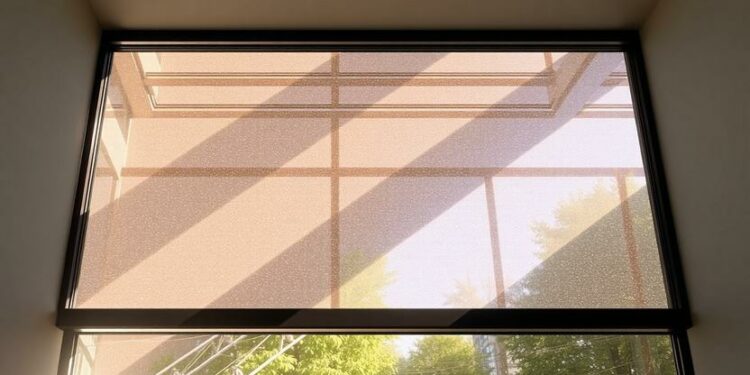
Scientists from the University of Exeter in the UK have developed a new type of smart window that regulates transparency and generates electricity at the same time. Its design is based on a combination of polymer-dispersed liquid crystals and integrated photovoltaic cells. This makes it possible to control the amount of light and heat entering a room while also harnessing solar energy to generate electricity.
Polymer-dispersed liquid crystals are a film with microdroplets of liquid crystals in a polymer matrix. When voltage is applied, the film becomes transparent; without voltage, it diffuses light, making the glass translucent. The new design combines the film with solar cells inside a double-glazed window, which turns the window into a multifunctional system.
Previous attempts to combine smart glass and solar panels often resulted in efficiency losses or unstable operation. The researchers have managed to achieve more consistent results. They tested two configurations: one with a liquid crystal layer placed closer to the sun, and the other with the solar cells placed first. They found that both configurations were virtually identical in terms of thermal parameters and overheating protection, with a minimal difference in efficiency.

The prototype consisted of a double-glazed window with acrylic layers that contained the film and six small solar cells. The window became transparent at a voltage of about 20 V. The tests were conducted under lighting conditions close to real sunlight, with constant monitoring of temperature and electrical characteristics.
In transparent mode, the window transmits some 62% of sunlight, maintaining high lighting quality. When switched off, its light transmittance drops to 42%, with overheating protection increasing significantly.
This means that the window is adaptable: it can either transmit more light or reduce the heat load on the room.
Generally speaking, the solution developed by the British researchers is yet another step towards improving the energy efficiency of buildings. These smart windows can provide glazing, solar protection and power generation at the same time, reducing the load on air conditioning systems and overall power consumption.
Source: Global Energy Association