By Oke Peter
Public frustration over unreliable electricity has again surfaced in several parts of Nigeria, with residents and small business owners staging protests to demand improved power supply. Demonstrations have recently been reported in Lagos, Delta, Osun and other states where communities complain that prolonged outages and high electricity tariffs are crippling livelihoods. The protests reflect a growing sense of exhaustion among consumers who depend on stable electricity for businesses, refrigeration, communication and household needs.
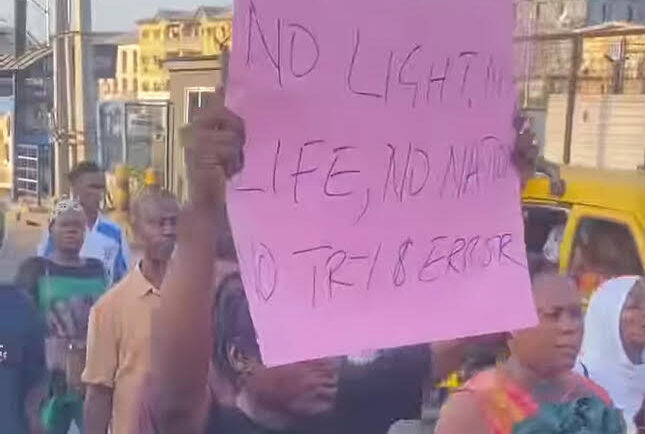
In Lagos, residents in some densely populated areas took to the streets on Thursday to protest what they described as months of erratic electricity supply despite rising tariffs. Small traders, artisans and shop owners said the situation has forced them to rely heavily on petrol and diesel generators, pushing up operating costs at a time when inflation is already high. Similar grievances have emerged in Delta State where residents accused electricity distribution companies of charging higher rates without delivering the promised hours of supply. Some protesters argued that communities placed under the premium electricity tariff category were supposed to receive up to 20 hours of daily electricity but rarely experience anything close to that level.

Protests or threats of demonstrations have also been reported in parts of Osun and Anambra states, where community groups say entire neighborhoods sometimes go days without electricity. For many Nigerians, the issue is not only the absence of power but also the uncertainty of supply. Businesses cannot plan production schedules and households cannot predict when electricity will return after outages.
Although protests in Nigeria often carry political undertones, the current wave of demonstrations appears largely driven by consumer frustration rather than organized partisan mobilization. Most of the protesters are residents, youth groups and informal sector workers who depend on electricity for economic survival. Their demands focus mainly on improved power supply, fair billing practices and greater accountability from electricity distribution companies. Placards and chants at protest grounds have largely targeted electricity providers and regulators rather than political parties.
Nigeria’s electricity crisis is rooted in a major gap between the country’s installed power generation capacity and the amount of electricity that actually reaches consumers. Official figures show that Nigeria has an installed generation capacity of roughly 13,600 megawatts. However, due to gas supply shortages, aging infrastructure and transmission bottlenecks, actual electricity delivered through the national grid typically ranges between about 4,000 and 5,500 megawatts. For a population of more than 200 million people, this level of supply is widely considered inadequate.
Power supply varies significantly across states. Major commercial centers such as Lagos, Abuja and Port Harcourt sometimes receive relatively better supply because of stronger transmission infrastructure and higher industrial demand. Even in these cities, however, electricity outages remain common and can last for several hours or days. In many other states, especially those with weaker distribution networks, power supply is often rationed through feeder systems that rotate electricity between communities.
Several structural challenges continue to limit electricity generation and distribution in Nigeria. Most power plants rely on natural gas, but many generation companies owe large debts to gas suppliers, leading to periodic reductions in fuel supply. Transmission infrastructure also struggles to move electricity efficiently from power plants to distribution companies. The distribution segment of the sector faces its own problems, including insufficient metering, revenue losses from unpaid bills and widespread electricity theft.
Since becoming Minister of Power in 2023, Bayo Adelabu has highlighted certain improvements in the sector, including a reported peak generation of about 5,801 megawatts in 2025. The government has also continued work on projects aimed at upgrading transmission capacity and modernizing parts of the grid. Despite these efforts, the improvements remain modest compared to the country’s estimated electricity demand, which analysts say could exceed 30,000 megawatts for reliable nationwide supply.

Questions have also been raised about Adelabu’s political ambitions, particularly speculation that he may contest the governorship of Oyo State in the future. Critics argue that persistent power shortages indicate that reforms in the sector have not progressed fast enough. They suggest that the focus of the ministry should remain firmly on resolving structural challenges in generation, transmission and distribution.
Supporters of the minister, however, maintain that Nigeria’s electricity crisis developed over several decades and cannot be fixed quickly. They argue that issues such as underinvestment, aging infrastructure and financial instability within the power sector require long-term reforms and significant capital.
What the protests ultimately reveal is a widening gap between public expectations and the pace of improvement in the power sector. As energy costs rise and businesses struggle with generator expenses, electricity has become both an economic and social pressure point. Unless the structural weaknesses of the sector are addressed in a sustained and transparent manner, public dissatisfaction with electricity supply is likely to continue fueling periodic protests across the country.