A better course is lean carbon: a minimal, time-limited overdraft of emissions to buy dependable power now, with covenants that force an early peak and a rapid decline. Think of it as carbon on credit, a capped facility, not a blank cheque.
Africa’s cumulative energy-related CO₂ to date is 3%
Sources: United Nations (World Population Prospects 2024), IEA Africa (2022)
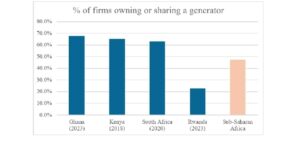 Sources: World Bank Enterprise Surveys (WBES), IFC The Dirty Footprint of the Broken Grid (2019), World Bank (Foster & Steinbuks 2009)The gas-only headache
If fossil molecules must feature, natural gas is preferable to oil products: fewer local pollutants and roughly half the CO₂ of coal per kWh. But gas-only is a mirage in much of Africa because pipes and LNG are scarce and markets are small. Outside a few corridors there are only a handful of regional gas arteries, notably the West African Gas Pipeline from Nigeria to Ghana and the line from Mozambique to South Africa. Grand schemes to extend them have moved slowly. Most countries lack the demand density to finance pipelines or import terminals. Insisting on gas everywhere, now, often means no power at all.
Sources: World Bank Enterprise Surveys (WBES), IFC The Dirty Footprint of the Broken Grid (2019), World Bank (Foster & Steinbuks 2009)The gas-only headache
If fossil molecules must feature, natural gas is preferable to oil products: fewer local pollutants and roughly half the CO₂ of coal per kWh. But gas-only is a mirage in much of Africa because pipes and LNG are scarce and markets are small. Outside a few corridors there are only a handful of regional gas arteries, notably the West African Gas Pipeline from Nigeria to Ghana and the line from Mozambique to South Africa. Grand schemes to extend them have moved slowly. Most countries lack the demand density to finance pipelines or import terminals. Insisting on gas everywhere, now, often means no power at all.Policymakers have improvised. Ghana plugged supply gaps with a floating powership that initially burned heavy fuel oil, then switched to domestic gas once supplies and connections were ready. Senegal has commissioned Heavy Fuel Oil-capable plants built to convert to gas when new fields and pipes arrive. These are bridges engineered to shorten the dirty phase, not invitations to lock-in.
What a workable plan looks like A credible lean-carbon pathway is neither all-renewables tomorrow nor gas for ever. It has three moving parts.1. Power plants that can switch fuels
New power stations should be able to start running right away—using heavy fuel oil or diesel if needed—but be built so they can easily switch to natural gas when supplies become available. This avoids blackouts today without locking countries into oil and gas for decades. Modern reciprocating engines can start and stop quickly, making them ideal substitutes for solar and wind power when the sun isn’t shining or the wind isn’t blowing.
2. Fossil fuel use that drops over time
Fossil fuels should be relied upon only when necessary, shifting focus to using them for system stability and renewable-scarce periods. If they are the only means of electricity generation, we should systematically seek to decarbonise them. That way, emissions per unit of GDP fall fast, even before absolute emissions peak. The first target is to displace diesel generators, the dirtiest and costliest kilowatt-hours on the continent.
3. Covenants that bind
To make sure the “carbon overdraft” stays small and temporary, it needs hard limits. These include deadlines for switching to cleaner fuels, limits on total emissions, and power purchase agreements that reduce payments to conventional plants as renewables and storage grow. The focus should be on financing the whole energy system - renewables, backup power, and better transmission lines - not just individual plants.
One final objection is to wait for cheaper batteries. Storage costs are falling and Africa should adopt them early. But telling a low-income country to wait five years for round-the-clock electrons is not climate policy; it is development deferred. High costs of capital already hobble clean projects. Suppressing growth makes those costs worse. Better to grow with discipline, shrink diesel immediately, and use rising demand to make gas and storage bankable, then retire the fossils on schedule.
The ask For energy ministries and regulators: publish peak-and-pivot plans that show when emissions will crest and what will force them down. Bake overdraft covenants into every firm-power tender. Allow dual-fuel where necessary, but mandate gas-ready design, switch-by dates and emissions-intensity floors.For development financiers and multilaterals: fund hybrids and grids, not single-fuel bets. Reward early conversion and managed retirement. Deploy guarantees to cut the cost of capital for storage and transmission.
For developers and independent power producers: bid least-carbon firm power, not cheap today and stuck tomorrow.
Africa does not seek permission to pollute. It seeks permission to end energy poverty quickly while peaking emissions early. That is the lean-carbon bargain: a small, declining hump instead of a long, dirty plateau, and a faster route to the sunny side of the Kuznets curve. The task for partners is to help keep the overdraft small, and to pay it back fast.
•Louis is the Director of Growth and Development for Africa and Europe at Wärtsilä Energy