Good morning.
Let me begin by thanking the Prime Minister and the people of Thailand for your generous hospitality. Deputy Prime Minister, Governor—thank you for the care and hard work you and your teams have put into these Meetings. And to our Chair, thank you for your leadership. It is a pleasure to be here with all of you.
In the months before I joined the World Bank Group in June 2023, three truths emerged clearly from conversations with shareholders, clients, private sector leaders, philanthropies, and others.
The challenges were great. Resources were limited. And the World Bank Group needed to face the wind.
Three years later, the wind has not eased. Conflicts persist. Fiscal space is tighter. Debt burdens have risen. And cost of essentials—from energy to fertilizer—remains high.
Meanwhile, a demographic transformation is unfolding.
Over the next 10 to 15 years, 1.2 billion young people will arrive at a job market projected to offer only about 400 million jobs.
This generation will shape the next century. The choices we make today will help determine how.
Those are the twin challenges we have been working to address:
Making scarce resources go further… while helping countries create jobs at scale.
They must be addressed together.
Over the past three years, I have used these Annual Meetings to lay out the work we were undertaking, changes we were making, and the ambition behind them.
This year, I want to focus on our progress—and where it is taking us.
The future of development will depend on bringing public finance, private investment, philanthropy, and technology together around what each country needs.
The partnership—and mix—should evolve as countries do.
Where needs and risks are greatest, public and concessional finance will remain essential. As countries grow stronger, private investment and access to markets should play a larger role. And to be clear success arrives when we are no longer needed by a country.
We have seen that journey. Thirty-five countries have moved from IDA to IBRD. Twenty-three are now IDA donors themselves. That is exactly what we want, and our strategy is built around what makes that progress possible.
It began with changing the World Bank Group itself.
We cut project preparation from 19 months to nine. Replaced 153 scorecard measures with 22 focused on impact. Increased pay-for-results financing from about one-third to half. Brought our public and private sector teams together around country-led strategies. And reengineered our balance sheet—creating more than $100 billion in additional IBRD lending capacity over a decade.

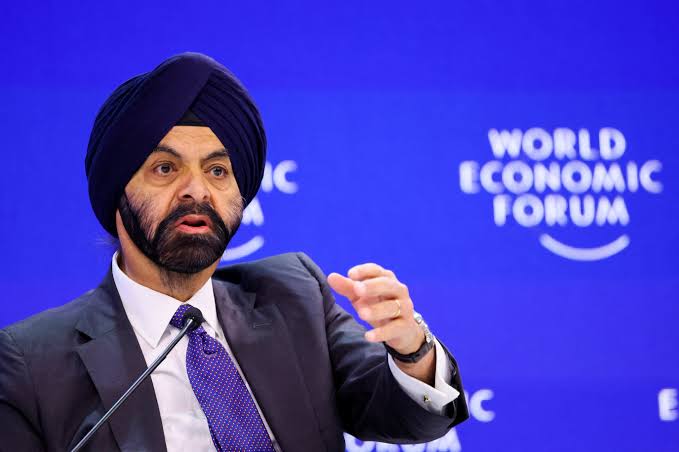
•World Bank Group President, Ajay Banga
We are also making it easier for MDBs to work together.
The number of projects on our digital co-financing platform has tripled in two years to about 250 projects, seeking $138 billion in financing. We are cutting duplication by relying on each other’s work with the Asian Development Bank, Inter-American Development Bank and EBRD—and expanding that model.
Taken together, these changes give us greater capacity.
Our jobs strategy gives it direction.
The Jobs Council drew on experience across countries and sectors to identify policies and programs that create more and better jobs. The strategy that emerged rests on three pillars.
First, physical and human infrastructure. Employers need electricity, water, transport, and digital connections. People need health, education, and skills. Last year, we committed $40 billion—nearly one-third of our financing—to these foundations.
Second, regulatory and policy certainty. Businesses of every size depend on strong institutions, good governance, and clear rules—from simpler permits to predictable land laws. Last year, 30 percent of our public sector financing supported policy and institutional reform.
Third, scale. Even with strong foundations and clear rules, some risks still hold investment back. The Private Sector Investment Lab helped us focus on those barriers—from currency risk to access to finance—and strengthen the tools to address them: guarantees, equity, and local currency financing.
That is how we bring more private capital into development.
The results are beginning to show.
In FY22—the year before our workplan began—we mobilized roughly $35 billion in private capital. Last year: $112 billion. A threefold increase.
Alongside our own financing, total financing exceeded $230 billion.
Gains are being felt across the spectrum. Mobilization nearly tripled in lower-middle-income countries, quadrupled in upper-middle-income countries, and more than doubled across Africa.
Our challenge is that in low-income countries, where attracting commercial capital remains hardest, mobilization held flat. The path to the poorest and most fragile economies runs through their small businesses—often growing where larger companies have yet to take root. Our new MSME strategy aims to reach where opportunity is hardest to come by.
Participation is broadening too.
Last year, we mobilized capital from investors in 110 countries. The United States, United Kingdom, and India led the way. But investors also came from Romania, Chile, Poland, and Brazil.
More countries are attracting investment. More are supplying it.
Across it all, nearly 55 percent of our financing and the private capital we mobilized went to infrastructure and energy, agribusiness, health, tourism, and value-added manufacturing—sectors that we are focused on to create jobs.
And total World Bank Group climate co-benefits reached $96 billion—$48 billion came from private capital. $96 billion. One institution. One year.
But financing is only the beginning.
The real value is bringing that capacity together around what each country is trying to achieve. That is why country strategies and compacts matter. Roadmaps built around a country’s ambitions, the results we are trying to achieve together, and the investments and reforms required to get there.
The roadmap is bespoke. The discipline is consistent.
We show up bringing public and private sector capabilities together from the start. We use IDA and our balance sheet where public and concessional resources are needed, align with philanthropic and operational partners, and mobilize private capital where markets can support it.
Technology amplifies that work.
“Big AI” requires computing power, energy, data, specialized skills, and capital that put frontier models beyond many developing countries’ immediate reach.
But practical, or “small,” AI can help a farmer improve yields, a teacher tailor instruction, a health worker make better-informed decisions, or an entrepreneur reach new customers. So we are helping countries build the electricity, connectivity, device access, and safeguards to put those tools to work.
Skills are part of the package—connecting education and training more closely to the jobs and industries countries are building.
So are small businesses. Our MSME strategy, launched earlier this week, is designed to make firms more visible, connected, enabled, and funded—using digital records to improve access to finance, link smaller businesses to larger buyers and markets, and simplify the rules that allow them to grow.
Critically important, in fragile and conflict-affected settings, where conditions do not yet support larger companies, small businesses play an outsized role in creating jobs and laying the foundations for stability.
Embedded across everything we do—building resilient infrastructure and stronger institutions so progress lasts.
That is what we refer to as smart development.
Our method is producing results.
Start with energy.
Through Mission 300, our ambition with the African Development Bank is to bring electricity to 300 million people in Africa by 2030.
So far, 59 million have gained access. And the pace has accelerated—from 12 million in FY24, to 18 million in FY25, to 29 million last year.
But access is only part of the challenge. Homes, mines, factories, farms, and growing cities need reliable, affordable baseload power.
Our approach is balanced by design—a full mix of renewables, hydro, gas where appropriate, nuclear where it makes sense, transmission, grids, and storage. That includes supporting nuclear retrofits with the IAEA—the first such work in 50 years.
On water, our ambition with partners is to improve water security for up to one billion people by 2030, with the World Bank Group committed to 400 million. Twenty country compacts give us a path to reach 150 million people with clean water. Twenty more compacts are on the horizon.
In agriculture, private, philanthropic, and operational partners are working to help 300 million smallholder farmers move from subsistence to surplus by 2030, with the World Bank Group committed to 200 million. We built a pipeline to support 82 million farmers in AgriConnect’s first full year and are doing the spade work for the next 118 million.
Through HealthWorks—supported by the Japanese government—our ambition is to reach 1.5 billion people with quality, affordable health services by 2030. Roughly 600 million have already been reached. The same model is showing up in newer areas.

In critical minerals, we plan to multiply our business five times in five years. This week, we launched our first country compacts with MDB partners—to build local industries and keep more jobs and value at home. We’ve identified 20 countries who we could partner with on this work.
In economic corridors, we launched 52 new projects last year—up from 20 three years earlier. With partners like the European Commission’s Global Gateway, Italy's Mattei Plan, and the United States' DFC, we are bringing infrastructure and investment together.
The infrastructure connects places. The opportunity grows along the way.
In Lobito, a route principally for minerals is increasingly carrying farmers’ crops to markets—and helping towns and cities grow.
Different sectors. Different countries. Different solutions.
Same objective: advance development and generate jobs.
The next phase is execution at scale.
That means meeting private-sector clients where they invest and make decisions.
We are expanding our presence in New York, Frankfurt, Milan, and Tokyo—to originate opportunities, solve problems faster, and build stronger pipelines.
But stronger pipelines are only part of the answer.
Development finance has always faced a basic constraint: a dollar can only be in one place at a time. Finance a power project, and that capital is fixed for decades—unavailable for the next water system, rail corridor, or clinic countries need.
Meanwhile, pension funds, insurers, and sovereign wealth funds manage enormous pools of long-term capital looking for long-term investments.
We are making the introduction.
Six multilateral development banks are creating common ways to assess, document, package, and transfer investments—so a project we help finance today can be held by another investor tomorrow, freeing our capital for the next one.
Repeated across institutions and markets, that begins to create something much bigger: an emerging-market development asset class. If we get this right, the size of our balance sheet no longer defines the scale of our ambition—and we will bend the curve of development forever.
Let me end where this institution began.
In 1944, with the world still at war, delegates from forty-four nations gathered in the mountains of New Hampshire.
They had every reason to turn inward. Instead, they made a wager: that rebuilding one nation could strengthen others, and recovery was a shared responsibility.
They did not build a monument to charity. They built a Bank and a Fund.
They understood something we must never forget: prosperity is not a prize one nation wins from another. It is a fire that warms every house within reach.
As countries’ needs changed, this institution changed with them—developing new ways to finance development and support private enterprise.
Building knowledge over decades of work.
Our people carry that inheritance forward. Their expertise turns lessons from one country into possibilities for another. Their commitment turns those possibilities into progress.
They are the strength of this institution—and the reason we can ask more of its future.
Today, the challenge arrives as arithmetic: a gap of roughly 800 million jobs. Behind that number is a young woman with a degree and no employer. A young man with a trade and no electricity. A generation asking: is there a place for me?
A job is not a statistic. A job is dignity.
It is the difference between a young person who can build a future; and a young person awaiting one. Leave that potential unrealized, and the consequences cross border.
Give it opportunity, and the benefits cross borders too. That is why development is an investment in our collective future.
This institution is rising to that challenge.
Not to recreate the development model of the last generation—but to build one equal to the expectations of the next. A model that evolves as countries do.
Public money where markets can't yet reach. Private capital where it can create jobs and scale. Philanthropy to take early risk and unlock new ideas. Technology to make every dollar go further.
And a World Bank Group that brings it together around what each country needs. That is the future of development we are working toward.
The jobs gap is a projection. It does not have to be our future.
We have begun to show what this model can deliver. Now we must give it the scale and pace the next generation demands.
That future is ours to build.
•Ajay Banga is the World Bank Group President.