By Oke Peter
Thunderstorms and lightning have fascinated human beings for thousands of years, giving rise to both myths and scientific discoveries. In many ancient cultures, thunder was believed to be the action of powerful gods. In Nigeria, for example, Sango is traditionally regarded as the god of thunder, believed to hurl thunderbolts as weapons. Today, science has shown that thunder and lightning are not acts of deities but natural electrical events caused by the movement of charges inside storm clouds.
As the world searches for cleaner and more reliable energy sources to ensure that every home has electricity, some have wondered whether the enormous power displayed during thunderstorms could be captured and converted into usable electricity. Although this idea sounds attractive, scientific research shows that thunderstorms cannot serve as a practical source of electric power for towns or cities.

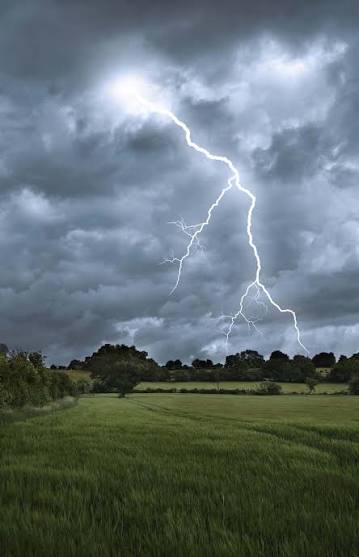
Lightning is a sudden electrical discharge that occurs when opposite charges build up in a cloud, between clouds, or between a cloud and the ground. Inside large storm clouds, known as cumulonimbus clouds, strong air currents cause ice particles and water droplets to collide. In this process, lighter particles tend to carry positive charges upward, while heavier particles carry negative charges downward. This separation of charge creates a very high electric potential difference, often reaching tens to hundreds of millions of volts. When the electric field becomes strong enough to overcome the insulating property of air, a rapid discharge occurs — this is lightning. The intense current heats the surrounding air to temperatures of about 30,000°C, which is hotter than the surface of the sun. The heated air expands explosively, producing the sound wave we hear as thunder.
A single lightning strike carries a large amount of energy, but it is released in an extremely short time. The total energy of an average cloud-to-ground strike is estimated to be between 1 and 10 billion joules (about 1 to 5 gigajoules). In electrical terms, 1 gigajoule equals about 278 kilowatt-hours (kWh). This means that, in theory, a single strong lightning strike could contain enough energy to power a typical household for several days. On paper, this seems impressive.
However, the practical challenge lies not in the amount of energy, but in how it is delivered. Lightning is highly unpredictable. Although about 100 lightning strikes occur every second around the world, only a portion reach the ground, and there is no reliable way to control where or when they will strike. Even if very tall towers were built to attract lightning, engineers still could not guarantee that strikes would hit a specific collection system at the right time.
Another major problem is duration. A lightning strike typically lasts only a few microseconds to a few milliseconds. Because the energy is released in such a short time, the instantaneous power is extremely high. While this sounds beneficial, it actually makes capture very difficult. Electrical grids require steady, controlled flows of electricity. Batteries, transformers, and other equipment are designed for stable input. A lightning strike, by contrast, delivers an enormous surge all at once, which would likely destroy most conventional equipment or result in most of the energy being lost as heat.
Furthermore, not all the energy in lightning is available as usable electrical energy. A significant portion is lost as heat, light, and sound. Even if engineers could intercept the strike, they would still need to convert it into stable alternating current (AC) that matches grid standards. This conversion process would add further losses and technical complications.
When scientists and engineers evaluate the idea of harvesting lightning, they generally conclude that it is not economically or technically viable. Building infrastructure strong enough to survive repeated lightning strikes would be extremely expensive. Even then, the system would sit idle most of the time, waiting for unpredictable events. Compared to renewable sources such as solar and wind — which provide continuous, controllable, and increasingly affordable power — lightning is unreliable and inefficient.

A simple calculation shows the scale of the problem. If one lightning strike provides about 278 kWh (1 gigajoule), and a small town of 10,000 homes requires around 20,000 kWh of electricity per day, dozens of perfectly captured lightning strikes would be needed every single day just to meet basic demand — assuming 100 percent efficiency, which is impossible in reality. In practice, many more strikes would be required. Modern power systems operate in megawatts (1 megawatt equals 1,000 kilowatts) and must supply electricity continuously over hours and days. Lightning’s brief flashes cannot meet this requirement.
There are also common myths about lightning. One popular belief is that lightning never strikes the same place twice. In reality, tall structures such as skyscrapers and communication towers are struck multiple times, sometimes several times during a single storm. Another misunderstanding is the confusion between high voltage and useful power. Voltage alone does not equal usable energy; what matters is controlled current delivered steadily over time. Lightning provides neither control nor continuity.
Scientific research today focuses on improving lightning detection systems, enhancing building protection, and reducing risks to infrastructure. Although experiments and theoretical discussions about harvesting lightning energy have been conducted in the past, none have produced practical results. The idea remains more of a scientific curiosity than a realistic energy solution.
In conclusion, thunderstorms are powerful natural events caused by charge imbalances in storm clouds. While a lightning bolt contains a large amount of energy, it is released too suddenly, unpredictably, and destructively to be captured efficiently with current technology. For these reasons, towns and cities cannot depend on thunderstorms as a reliable or economical source of electricity.