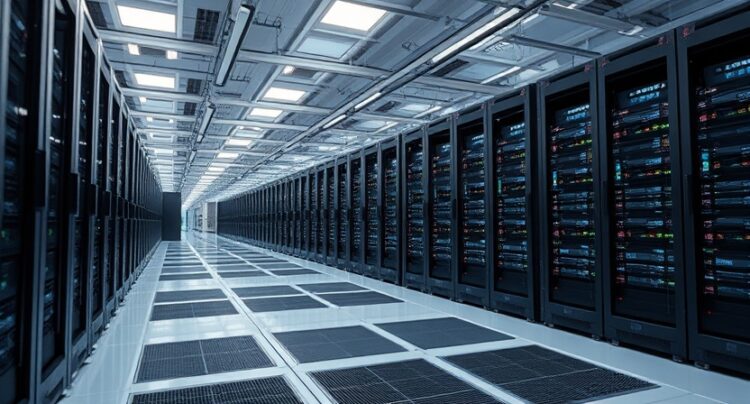
By 2030, the data centers of major technology companies will consume up to 295 TWh of electricity per year, which is equivalent to about 1% of global electricity demand. These estimates have been presented in a study conducted by scientists from Ohio State University in the United States and Zhejiang A&F University in China.
The researchers analyzed the development of data centers owned by the world’s largest technology companies, such as Amazon, Microsoft, Google, Oracle, Apple and Meta (designated as an extremist organization in the Russian Federation), which operate hyperscale data centers linked to cloud services. These companies account for about 70–75% of global power consumption in this sector.

After studying corporate reports, investment plans, government documents and media publications, the researchers identified where these tech giants are most likely to expand their computing infrastructure. Then, they calculated the energy consumption of these facilities, factoring in the number and capacity of computing accelerators, operational intensity and cooling costs.
The scientists reviewed three infrastructure development scenarios: conservative (15% annual capacity growth), neutral (25% capacity growth) and optimistic (35% capacity growth). The calculations showed that, depending on the scenario, the data center electricity consumption of these six companies could reach 239–295 TWh by 2030. According to a forecast by the International Energy Agency cited in the study, data centers worldwide could be consuming around 945 TWh, or about 3% of the world’s electricity, by that time.
However, this load will be distributed very unevenly around the globe. More than 90% of the projected computing capacity of the major companies will be concentrated in North America, Western Europe and the Asia-Pacific. Data centers are primarily built in areas with access to large amounts of electricity, well-developed power grids and telecommunications infrastructure, favorable climatic conditions and government support.
This load could make the largest impact on relatively small energy systems. Oregon, Virginia, Iowa, Ohio and Ireland will emerge as the largest centers for data center energy consumption: annual consumption could exceed 15 TWh by 2030 in each of these areas. Not far behind are Texas, the Netherlands and the state of Washington, where demand will be somewhat lower while also continuing to grow rapidly. It should be noted that, aside from the absolute volume of consumption, the size of the power grid matters as well: for instance, the new load will be much more impactful for Oregon, Iowa and Ireland, whereas Texas’s large power grid will be able to handle it with less strain.
The study once again highlights the growing role of artificial-intelligence infrastructure in the global energy mix. High-performance processors which are used to train and operate large generative models require much more electricity than conventional server hardware. The growth of computing power, in turn, increases energy consumption for cooling equipment and powering other data-center infrastructure.
Source: Global Energy Association