As the capacity of battery packs in electric vehicles has increased, the danger posed by a battery fire has also increased. However, the rate of battery fires has decreased significantly since the 2010s. This is due to improvements in several battery pack technologies, including sensor deployments, fire protection materials, thermal management systems and battery management systems. The battery management system (BMS) acts as the 'brain' of the battery pack, taking in data from sensors and utilizing it to enable safe operation of the battery. IDTechEx provides deeper insights into emerging technologies in the BMS landscape in its most recent report "Li-ion Batteries and Battery Management Systems for Electric Vehicles 2026-2036", including potential improvements to vehicle charging, safety and lifetime.
Advanced battery management system players - hardware and software
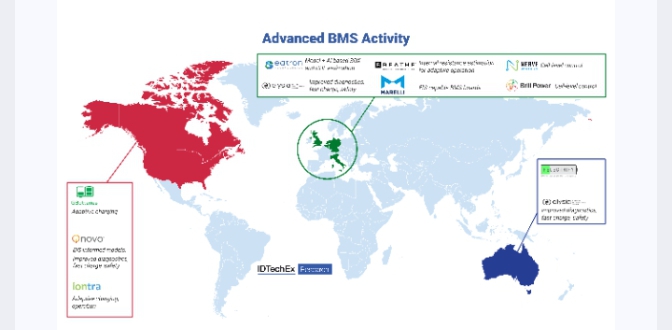
There are many approaches to improving BMS capabilities. This includes both hardware-based and software-based approaches. On the software side this includes: adaptive charging algorithms from Iontra, Elysia, GBatteries and Breathe Batteries, and advanced diagnostics from Eatron and Qnovo. On the hardware side, this includes: cell-level control from Brill Power, Nerve Smart Systems and Relectrify and electrochemical impedance spectroscopy (EIS)-capable BMS boards from Marelli. There are many players operating in this space, as well as developments from automotive OEMs and battery developers. The focus is primarily on achieving faster charging and safer, longer battery operation.

Advanced BMS activity from key players in key regions. Source: IDTechEx
Cloud analytics - increasing adoption for BESS and mobility fleets
IDTechEx has also noticed a growing trend of BESS and mobility fleet operators utilizing external data analysis services, specifically cloud analytics. The premise of this approach is that the analysis performed by the BMS itself is limited by the processor in the BMS. By exporting data to the cloud and performing diagnostics on more powerful computers, better predictive power can be achieved. The focus is primarily on achieving improved diagnostics, however better operational management can also be achieved e.g. using adaptive charging protocols that reduce degradation. LFP batteries are particularly challenging to model for conventional state of charge (SoC) and state of health (SoH) algorithms used by standard BMS chips, and benefit significantly from cloud analytics. By taking in data from BMS across the entire fleet, fleet-wide problems can also be identified, including non-optimal usage strategies.
Players in this space (e.g. TWAICE, ACCURE) have experienced significant growth in the last few years, with this technology being deployed in MWh-scale battery deployments in the BESS and mobility markets. IDTechEx predicts that by the end of 2026, more than 25 GWh of BESS and mobility fleets will be managed through cloud analytics services. More information on the services offered by cloud analytics players can be found in IDTechEx's recent report "Li-ion Batteries and Battery Management Systems for Electric Vehicles 2026-2036".
wBMS - Ultium adoption
Another major design decision for the BMS is the communication protocol used. A standard BMS uses wired connections between sensors, module integrated circuits (ICs) and BMS boards, and in turn communicates with the vehicle's internal management system through the controller area network (CAN) bus. However, some players have developed wireless alternatives, utilizing e.g. Bluetooth, near field communications or proprietary communications protocols. The advantage of a wireless system is two-fold: firstly, it enables pack weight reductions and secondly it can enable cost reductions in large battery packs, in which wiring would be complex. However, wireless systems also suffer from security challenges, which has prevented wide-scale deployment.
General Motors (GM) was the first major automotive OEM to integrate a wireless BMS (wBMS) into its cars, specifically within the EV3 battery platform for Ultium battery packs. The BMS was developed in collaboration with Analog Devices and Visteon. For GM, it seems wBMS will continue to be the way forward, though it remains to be seen whether other automotive OEMs will also shift towards wireless systems.

Patent analysis - regional, player and topic trends
IDTechEx also conducted an in-depth patent analysis of BMS-related patents, to look for trends in patent topics, regions and assignees. This included a shift from hardware-focused patents to software-focused patents in the last five years, as well as a general increase in BMS-related patents applications since 2015. To better understand the BMS patent landscape, see IDTechEx's recent report.
IDTechEx outlook
IDTechEx's analysis indicates an increasing focus on integration of advanced BMS software in electric vehicles, for improved state of health (SoH) and state of charge (SoC) estimation and to enable fast charging. IDTechEx also anticipates potential deployment of alternative battery management system communications protocols, including wireless BMS. For more information on the BMS landscape, as well as Li-ion cell and pack trends and benchmarking of turnkey battery pack players, see IDTechEx's recent report "Li-ion Batteries and Battery Management Systems for Electric Vehicles 2026-2036".