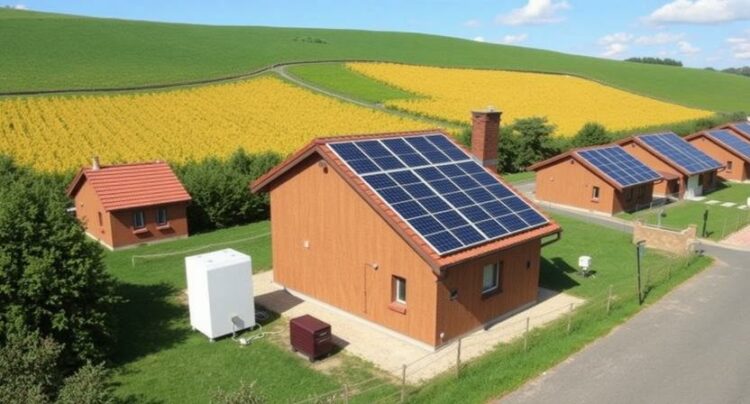
Researchers from the University of L’Aquila in Italy came forward with the idea to utilize surplus power generated by domestic solar panels to heat water and then convert the accumulated heat back to electricity when needed. Under optimal operation the system they developed could cover the modelled household’s daily demand for electricity, while the overall efficiency of its storage cycle amounted to 35%.
The development is based on what is known as the Reversible Carnot Battery. Unlike the conventional electrochemical storage battery, it stores energy as heat. The unit proposed by the Italic research team combines a heat pump with the Organic Rankine Cycle (ORC), with part of the equipment involved in both cycles. When excess solar energy is produced the unit works as a heat pump: electricity powers the compressor which transfers heat from the cooler source to the water contained in a thermally insulated tank. Electric power is effectively converted to heat which is stored by hot water.

When the solar panels fail to provide sufficient electricity for the household the process switches to the reverse mode: its accumulated heat is transferred from heated water to the operating fluid with low boiling temperature. The latter evaporates and expands within the same rotating machine that served as compressor during the charging cycle and which now operates as expander to generate electricity. This process is known as Organic Rankine Cycle. It differs from the conventional steam cycle in that, instead of water, it uses an organic liquid that evaporates at a relatively low temperature.
To test the conceptual design, the researchers built a computer model of the system integrated with a domestic solar power plant in central Italy which includes 60 м² of solar panels. Modelling was performed for January conditions when solar power output is relatively low. Any surplus power, mostly generated between 6 a.m. and 3 p.m., was used to heat water. The researchers compared between 8 KL, 12 KL and 16 KL tanks and selected the 8 KL option with the capacity to heat water to nearly 100°C.
They found that one of the key parameters was the expansion tank rotation speed during the heat-to-power conversion phase. When it was reduced from approximately 1900 rpm to 1000 rpm, the heated water took more time to release energy and the unit could work for a longer period. After nine hours of optimal operation the system not only covered the household’s estimated electricity consumption but saved some 1.5 kWh. The cycle-wide efficiency (power generated at discharge divided by charging power consumed) was as high as 35%.
Admittedly, those are modelling results and not actual domestic unit test run results. The research team is planning to model the system’s operation throughout the year and determine how its performance will change depending on solar panel surface area and the parameters of specific components.
Source: Global Energy Association