By Gold Jeremiah
On January 15, 1956, a quiet fishing and farming community in present-day Oloibiri, Ogbia Local Government Area of Bayelsa State, became the birthplace of Nigeria's petroleum industry. Ironically, seven decades later, the community that unlocked the country's oil wealth remains one of the least developed oil-producing areas in the Niger Delta.
That contradiction is what makes Oloibiri one of the greatest oddities in Nigeria's energy history.
The discovery was made by Shell D'Arcy Petroleum, the exploration arm of Shell, which later became Shell-BP after partnering with British Petroleum (BP). The company had spent nearly two decades searching for commercial oil in Nigeria after receiving an exclusive exploration licence from the British colonial government in 1937. Exploration was interrupted by the Second World War before resuming in the late 1940s.

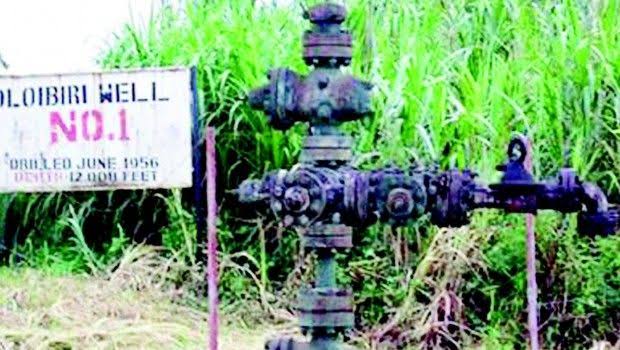
•Oloibiri oil well
Several exploratory wells failed before geologists drilled the Oloibiri-1 well to a depth of about 4,062 feet (1,238 metres). On January 15, 1956, the well struck commercial quantities of crude oil, marking Nigeria's first successful commercial oil discovery. The well was completed for production on June 5, 1956, and commercial production commenced in 1958.
Initial production averaged about 5,100 barrels of crude oil per day, with output peaking in the mid-1960s as additional wells were drilled. The field eventually operated 11 production wells, making Oloibiri the foundation upon which Nigeria's modern petroleum industry was built.
Although exact cumulative production figures are difficult to verify because detailed historical field records were never comprehensively published, industry estimates indicate that the Oloibiri field produced tens of millions of barrels of crude oil before production declined sharply. The field was eventually depleted and abandoned in 1978, barely two decades after it began commercial operations.
Yet the real mystery of Oloibiri is not how oil was found—it is what happened afterwards.
The discovery transformed Nigeria into one of the world's major petroleum producers. From exporting just 1.8 million barrels of crude oil in 1958, Nigeria's production eventually climbed above 2 million barrels per day within two decades, making oil the backbone of the national economy.
However, Oloibiri itself never experienced a corresponding transformation.

•Oloibiri oil well.
Visitors today encounter abandoned wellheads, rusting facilities and a community that still struggles with inadequate infrastructure, limited healthcare, poor roads and unemployment. Despite generating the wealth that financed much of Nigeria's post-independence development, Oloibiri has often been described as a symbol of the "resource curse"—where regions rich in natural resources remain poor while wealth flows elsewhere.
Perhaps the strangest chapter is that several attempts to immortalise the site have remained largely unfulfilled. Successive governments proposed building an Oil and Gas Museum and research centre in Oloibiri to preserve Nigeria's petroleum heritage, but progress has been slow, leaving the country's most historic oil location without the recognition many believe it deserves.
Another forgotten fact is that the crude discovered at Oloibiri was relatively heavy and sour, with an API gravity of about 20.6 degrees. During those early years, associated natural gas was simply flared because Nigeria lacked gas processing and utilisation infrastructure—a practice that continued across much of the Niger Delta for decades.
There is also an irony in timing. Before Oloibiri, agriculture dominated Nigeria's economy through exports of cocoa, palm produce and groundnuts. Within a generation, crude oil had displaced agriculture as the country's principal export and revenue source, permanently reshaping Nigeria's economic trajectory.
For today's energy industry, Oloibiri offers enduring lessons. First, discovering natural resources is only the beginning; sustainable development depends on how those resources are managed. Second, host communities must share meaningfully in the benefits of extraction if the industry is to maintain its social licence to operate. Finally, preserving industrial heritage matters. Countries that value their energy history protect landmark discoveries as national monuments. Nigeria's first commercial oil well deserves similar recognition.
Seventy years after crude first flowed from Oloibiri, the well no longer produces oil – but its story still produces something equally valuable—a reminder that the true measure of an energy discovery is not only the barrels extracted, but the legacy it leaves behind.
•Sources: EBSCO Research, Wikipedia & Historical Nigeria.