By Lee Nichols,
The continent is home to mega-scale projects on both its east and west coasts as its growing economies see rising demand for gas
Global gas demand is forecast to reach nearly 4.2tcm in 2025, according to the International Gas Union, marking a year-on-year increase of more than 70bcm. The rise is being led by various factors, including coal-to-gas switching for power generation, urbanisation, decarbonisation, trade and feedstock for growing datacentres.
These factors will continue to drive gas demand over the next few decades. For example, the Gas Exporting Countries Forum’s (GECF’s) Global Gas Outlook to 2050 forecasts that global gas demand will reach nearly 4.6tcm by 2030, surpass 5tcm by 2040 and increase to more than 5.3tcm by 2050 (see Fig.1). Consumption will be led by Asia and North America.
As demand for gas increases globally, hundreds of billions of dollars are being invested in gas processing plant infrastructure and LNG terminals. Global FLNG capacity is forecast to reach 42mt/yr by 2030, increasing to 55mt/yr by the mid-2030s, according to consultancy Rystad Energy.

Fig.1: Global natural gas demand outlook by region (bcm), 2030–2050. Source: GECF
At the time of publication, Gulf Energy Information’s Global Energy Infrastructure (GEI) database was tracking more than 310 active gas processing/LNG projects globally, totalling nearly $785b in capex. Most projects are in Asia, followed by the Middle East and the US. These three regions account for 64% of total active project market share, with the Asia-Pacific region accounting for nearly 30% alone (see Fig.2).

Fig.2: Total active gas processing/LNG project market share by region . Source: GEI database
Over the past decade, African gas demand has increased by roughly 60bcm/yr, reaching nearly 178bcm/yr in 2024, according to the Energy Institute. The rise in demand is primarily due to economic development and urbanisation, leading to an increased need for more electricity/power production. By 2050, African gas demand is forecast to reach 385bcm/yr, according to the GECF.
New gas discoveries and upstream investments are leading to additional spending on domestic gas and LNG infrastructure. Most project initiatives are focused on monetising the region’s vast reserves for domestic consumption, with surplus products exported to international markets.
Although Africa accounts for 11% of active gas processing/LNG project market share, the region’s total capital investments in the sector total more than $130b. This is primarily due to mega-scale LNG projects on both coasts in countries such as Nigeria, Mozambique, Mauritania, Senegal and Tanzania. These projects will help monetise domestic gas production and provide additional gas products for national and regional use.
Most active gas processing/LNG projects in Africa are in Nigeria and Mozambique. Active project market share for these nations is 29% and 18%, respectively.
Nigeria
Nigeria holds the largest gas reserves in Africa, and the country is working with international partners to monetise this resource to provide gas to the domestic market. The nation is investing in several projects, including both LNG terminal expansions and onshore processing facilities. These projects include:
The $6.5b Bonny Island T7 expansion project, which will boost the facility’s total production capacity from 22mt/yr to 30mt/yr. At the time of publication, the project was more than 80% complete. The project will help process additional gas production from the Shell-led HI gas project offshore Nigeria.
The expansion of the AHL gas processing plant and the construction of the ANOH gas processing plant. These projects will provide an additional 500mcf/d into the Nigerian gas market once completed. This gas will be used for power generation in the southeast of the country.
NNPC is working with various companies on the construction of five mini-LNG plants. These plants total nearly 100mcf/d of processing capacity. The produced natural gas will provide a cleaner and cheaper source of energy to households, industries and the country’s mobility sector.
Nigerian National Petroleum Company (NNPC) is also working with TotalEnergies on a $550m gas processing facility in the southern Rivers state. The facility will process gas produced from the Ubeta onshore gas field. Once treated, the gas will be sent to NLNG’s LNG plant.
Wison New Energies is developing a 3mt/yr FLNG vessel and 230MW power barge project. The FLNG vessel will be moored 10km offshore Nigeria. A portion of the received gas will be sent to a barge for power generation and to provide electricity to the LNG-operated gas assets and processing facilities in the Escravos and Forcados hub.
In late 2024, the Nigerian government initiated additional efforts to revive the Olokola LNG and Brass LNG projects. Collectively, these projects account for approximately $30b in total capital investments. However, at the time of publication, no movement had been made on these projects, although the Nigerian government announced in September 2025 that it is still committed to large-scale gas initiatives such as the Brass gas project. Gas and renewables projects are part of Nigeria’s Renewed Hope Agenda, which aims to increase the country’s economic development.
Mozambique
On the other side of the continent, Mozambique is also trying to develop its domestic gas sector. The country’s flagship project is the long-delayed $20b Mozambique LNG onshore terminal. The project has been plagued by various challenges, the most recent being safety issues regarding Islamic State-linked attacks in the country. However, the TotalEnergies-led project is expected to resume construction in 2026. The facility is expected to begin operations around 2029–30. ExxonMobil is also developing its own LNG onshore facility in the country. The $30b, 18mt/yr Rovuma LNG terminal will process gas from the consortium’s offshore operations.
11% – Africa’s share of active gas processing/LNG projects
In conjunction with upstream gas exploration and production and the midstream LNG terminal construction of ExxonMobil and TotalEnergies, Mozambique’s state-owned ENH plans to use an FSRU to import gas from offshore operations while onshore terminals are built. The vessel will be moored at the Port of Beira and be connected to the nearly 538-mile Rompco pipeline. This project will link gas from Mozambique’s fields to both the domestic market and South Africa—the Rompco pipeline is a joint venture between the Mozambican and South African governments, with Sasol holding a minority stake.

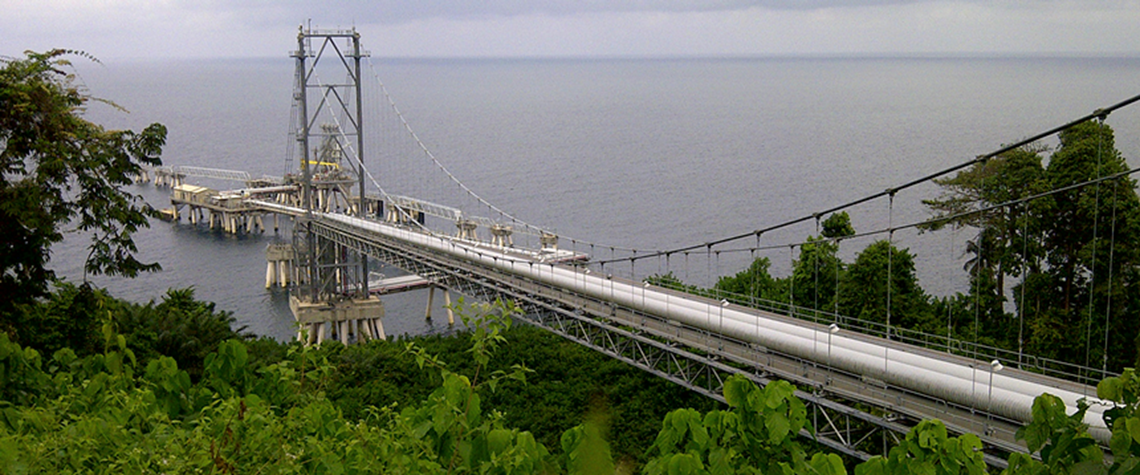
The world's first LNG pipe rack suspension bridge in Punta Europa, Equatorial Guinea
Africa Gas
Although the country’s onshore terminal construction projects have been delayed from initial estimates, Eni has made progress with offshore LNG production. In October, the Italian IOC announced a positive FID for the launch of its second FLNG vessel, Coral Norte. This vessel is a copy of its first Mozambique FLNG vessel, Coral Sur. Once operational, Coral Norte will double Mozambique’s LNG production to more than 7mt/yr.
Other countries
Additional active project market share in Africa is broken out among nearly a dozen countries. In October 2025, the government of Algeria announced plans to invest $60b over 2025–29 to boost domestic oil, gas and hydrogen activities. Although much of this investment will go towards upstream exploration and production operations, the nation is investing in new processing capacity to treat the gas. This includes the Hassi R’Mel LPG and condensate plant, the 12mcm/d Ain Tsila gas complex (commissioned in August 2025) and other facilities to process domestic. This gas will be treated and sent to the national grid for power generation.
Growing gas supply deficits are forcing Egypt to look at various pathways to provide additional supplies for domestic use. The country made significant gas discoveries in the offshore Zour field in 2015; however, the development of this massive field has been faced operational and technical challenges, forcing Egypt to import gas to satisfy domestic demand. This included ramping up imports via FSRU vessels. The country has positioned three FSRU vessels in Sin Sukhna and Damietta. These vessels are expected to begin imports by Q4 2025. In late 2026, a fourth FSRU will replace the existing vessel moored at the Port of Sumed near Ain Sukhna. These vessels will increase Egypt’s total regasification capacity from approximately 250bcf in 2024 to nearly 1,200bcf by 2028.
In Congo-Brazzaville, Eni plans to begin operations of the 2.4mt/yr Nguya FLNG in 2026. The vessel is in addition to the company’s Tango FLNG, which began operations in late 2023. The second FLNG vessel is part of Phase 2 of the 3mt/yr Congo LNG project, which also includes the installation of subsea infrastructure in the Marine XII concession offshore Congo.
In 2026, Perenco will begin operations on the $2b Cap Lopez LNG terminal in Gabon. The project will utilize a 700,000t/yr FLNG vessel that will help monetise domestic gas production, along with mitigating flaring from those operations.
$130b – Africa’s gas capital investments
To process additional gas from the Greater Jubilee and TEN fields, Ghana is launching a second gas processing train at its facility in Atuabo. The $700m project will help the nation move towards burning cheaper and cleaner gas for power generation in lieu of expensive liquid fuels. This project is complemented by the Tema LNG import terminal. Imported and domestically produced gas will help the nation satisfy increasing demand, with its gas demand is forecast to double by 2030.
BP is developing the Greater Tortue Ahmeyim project in Mauritania and Senegal. Phase 1 began production in January 2025. Phases 2 and 3 plan to increase production to 5mt/yr and 10mt/yr, respectively. However, at the time of publication, BP had not publicly announced the direction of Phases 2 and 3, which could include replacing the current FLNG vessel with a larger one. In Senegal, Kosmos Energy announced it may develop an offshore LNG facility to process gas from the company’ Yakaar-Teranga project. The project may include the use of a subsea pipeline that will transport gas produced offshore to an FLNG vessel moored near shore. The produced gas will be used for power generation, replacing imported heavy fuel oil and coal. Surplus product will be exported.
According to Morocco’s Ministry of Energy, the country’s gas demand is forecast to increase from approximately 1bcm/yr to more than 3bcm/yr by 2040. The increase in demand is driven by the country’s move away from coal for power generation. However, even with increased investments in gas production, the nation produces roughly a tenth of its domestic needs, forcing it to import volumes. In addition to receiving gas via a pipeline from Spain, Morocco is investing in new LNG and pipeline infrastructure.
For example, the country plans to develop a 500mcf/d LNG import terminal in Nador West Med Port. The project includes a 1,200MW power station and a 750mcf/d pipeline to send gas to demand centres in the country. These projects are part of the nation’s gas roadmap, which includes two phases. Phase 1 (2025–27) includes the construction of the Nador West Med Port LNG terminal, which will use an FSRU vessel for gas imports, as well as new gas transport pipelines. Phase 2 (post-2030) includes the construction of an LNG regasification terminal at the Dakhla Atlantic port, as well as more pipelines to transport gas to demand centres inside the country. A third phase (long-term) calls for pipeline connections to Mauritania and Senegal, as well as the development of domestic green hydrogen infrastructure.
29% – Nigeria’s share of active projects
South Africa is facing a potential gas crisis if additional infrastructure is not built. The nation relies heavily on imported gas from neighbouring Mozambique. However, Mozambique’s Pande and Temane fields, operated by Sasol, are forecast to cease providing imports in mid-2028, while South Africa’s domestic demand is expected to triple to around 700–800PJ by the mid-2030s. While the nation builds/installs new gas infrastructure, Sasol plans to supplement supplies by using methane-rich gas produced from coal at its Secunda plant. In the meantime, South Africa is developing at least three potential LNG terminals. The 2mt/yr Richards Bay terminal will use an FSRU and could expand to 5mt/yr if needed. Operations are scheduled to begin by 2028. The project, being developed by South Africa’s Transnet National Ports Authority, will join other potential terminals in the ports of Ngqura and Saldanha.
Finally, Tanzania is trying to develop its domestic gas sector. Like Mozambique, Tanzania has massive offshore reserves. To monetise these resources, Norway’s Equinor plans to develop $40b+ LNG project, which includes an onshore export terminal in Tanzania’s Lindi region. However, the project has been delayed several times due to unrest in the country and changes to the financial structure agreement between the developers and the government. Both are working to finalise an agreement to restart the project, which has been delayed for a decade.
•Lee Nichols, Vice-president, Content,
Gulf Energy Information
This article is extracted from the HPI Market Data 2026 report, published by Gulf Energy Information, and was written before the conflict in the Middle East. Click here to find out more.
Source: Petroleum Economist