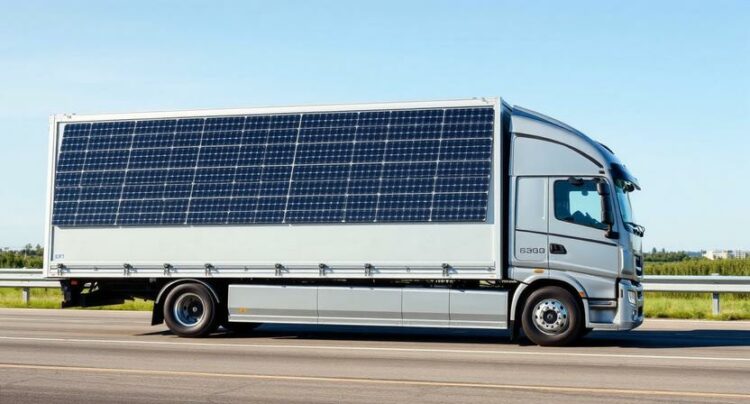
The solar panels integrated into electric vehicles might cover up to 55% of their annual energy consumption in Central Europe and up to 80% in southern Europe, according to the calculations made by researchers at the Fraunhofer Institute for Solar Energy Systems.
According to their estimates, if all the new cars sold in Europe by 2030 are equipped with such systems, electricity consumption from the grid will decrease by 15.6 TWh per year by the end of the decade. This is comparable to the annual energy consumption by several million European households.
The study focuses on VIPV technology which involves integrating photovoltaic systems directly into the structure of vehicles, the roof, the hood, and the side panels. As part of the project, the researchers analyzed 23 types of vehicles, ranging from compact city cars to heavy-duty trucks. To do this, the vehicles were equipped with sensors to collect data on movement and energy consumption over a distance of more than 1.3 million kilometers. The information obtained was compared with Meteosat satellite data and the European weather data to assess how much energy the integrated solar panels are able to generate under different climatic conditions.

The results show that the technology works most effectively on vehicles with a large roof area and a relatively low annual mileage, such as SUVs. In such cases, solar panels allow the vehicle to be plugged in for charging much less frequently and further reduce the load on the power grid.
The technology proves especially effective for logistics. Electric trucks and trailers have a large surface area for mounting solar modules, and at the same time, these vehicles consume energy continuously for cooling, heating, and operation of auxiliary systems. According to the researchers’ calculations, built-in solar panels can increase daily range of electric trucks by approximately 15%.
The study also shows that cargo trailers with the roof-mounted solar panels are able to generate up to 55 kWh of electricity per day in the summer. If the modules are additionally integrated into the side walls, daily output would increase to 90–110 kWh. This is sufficient to fully power refrigeration units or hydraulic systems.
The technology might also be useful for conventional diesel trucks. Solar panels are able to power air conditioners, heaters, and other auxiliary systems, reducing fuel consumption.
According to the project authors estimates, the resulting diesel savings would recuperate the cost of the built-in solar modules in less than two years.
Source: Global Energy Association