By Oke Peter
Many people assume electricity moves through power lines the same way water flows through a pipe. In reality, what travels through the transmission network is energy, while the tiny particles that carry electric charge—electrons—move much more slowly than most people imagine.
The distinction is important because it explains why electricity generated hundreds of kilometres away can power homes, offices and industries almost instantly.

Think of a long pipe filled with water. If you push water into one end, water begins flowing out of the other end almost immediately, even though the individual water molecules have not travelled the entire length of the pipe. Electricity behaves in a similar way. When a power station generates electricity, it creates an electric field that spreads through transmission lines at a speed approaching the speed of light—about 300,000 kilometres per second in a vacuum and typically 50 to 99 per cent of that speed in power lines, depending on the material and surrounding conditions. The electrons themselves, however, drift only a few millimetres per second in household wiring.
This means that when you switch on a light, the bulb does not wait for electrons to travel all the way from a power plant. Instead, the electric field rapidly pushes electrons that are already present in the wire, allowing energy to be delivered almost instantly.
The journey of electricity begins at power plants. In a hydropower station, falling or flowing water spins massive turbines connected to generators. The spinning motion converts mechanical energy into electrical energy through electromagnetic induction—the same principle discovered by scientist Michael Faraday nearly two centuries ago.
Nigeria has three major hydropower stations: Kainji, Jebba and Shiroro. Together, they provide more than 1,900 megawatts (MW) of installed generating capacity, although actual output varies depending on water levels, maintenance schedules and the condition of the national grid. Electricity produced at these stations is generated at relatively low voltages before being stepped up by transformers to very high voltages—typically 330 kilovolts (kV)—to reduce energy losses during long-distance transmission.
From there, the electricity enters the national transmission network operated by the Transmission Company of Nigeria (TCN). The grid consists of thousands of kilometres of high-voltage transmission lines linking power stations to substations across the country. At these substations, transformers reduce the voltage from 330kV to 132kV and then to 33kV and 11kV before electricity reaches distribution companies.
The distribution companies further reduce the voltage to about 415 volts for three-phase supply or 230 volts for single-phase supply used by homes and most small businesses. By the time electricity reaches a wall socket, it has travelled through several stages of voltage transformation designed to make transmission efficient and safe.

•Aerial view of Kainji Hydropower Station in Niger State
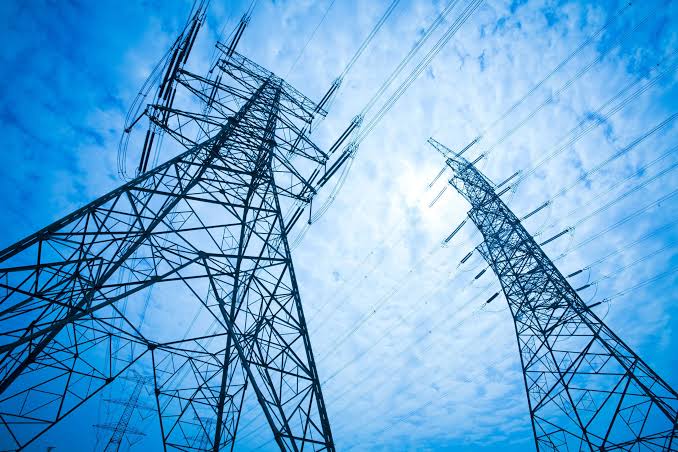
High-voltage transmission is essential because it significantly reduces energy losses. According to the principle expressed in Ohm's Law, increasing voltage allows the same amount of power to be transmitted with lower current, thereby reducing heat losses in transmission lines. This is why the giant steel towers seen across the country carry electricity at hundreds of thousands of volts rather than at household voltage.
One common misconception is that power lines are "empty" until electricity is generated. In fact, transmission conductors already contain vast numbers of free electrons. What power stations do is create the electric field that sets these electrons into motion, transferring energy through the network to consumers.
Another interesting fact is that electricity generated from hydropower is no different from electricity produced by gas-fired, solar or wind power plants once it enters the grid. The source of generation differs, but the electrical energy delivered to homes and businesses is the same.
Understanding how electricity travels helps explain why reliable transmission infrastructure is just as important as building new power plants. Even if enough electricity is generated, consumers cannot enjoy stable power without a strong and efficient transmission and distribution network capable of delivering that energy safely and with minimal losses.
So, the next time you flip a switch, remember: the electrons in your home's wiring are not racing all the way from a distant power station. Instead, they are responding almost instantly to an electric field travelling through the national grid, bringing energy from the generator to your appliance in the blink of an eye.